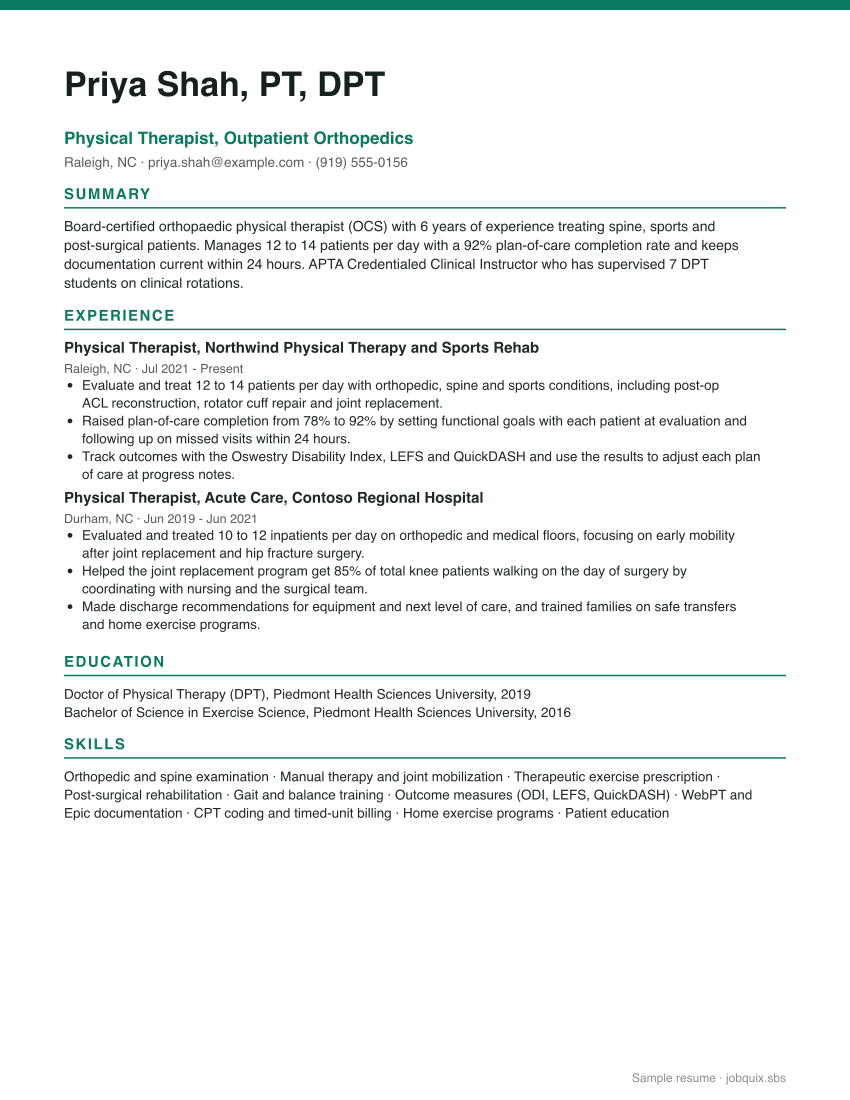
Physical Therapist resume summary examples
New graduate
New graduate physical therapist with a Doctor of Physical Therapy degree, a passed NPTE and an active state license. Completed 32 weeks of full-time clinical rotations in outpatient orthopedics, acute care and inpatient rehabilitation, carrying 80% of a full caseload by the final rotation. Brings strong manual therapy skills, clear patient education and efficient documentation.
Experienced
Physical therapist and clinic director with 11 years of outpatient orthopedic and sports experience and board certification as a Sports Clinical Specialist (SCS). Leads a team of 6 PTs and 3 PTAs and grew patient visits 25% in two years by building referral relationships with 5 orthopedic practices. Mentors staff toward specialist certification and residency training.
Changing settings
Hospital-based physical therapist with 5 years of acute care experience moving into outpatient orthopedics. Treats 10 to 12 patients a day after joint replacement, spine surgery and trauma, and plans safe discharges with nursing and case management. Completed 60 hours of continuing education in manual therapy and sports rehabilitation.
Need more ideas? See resume summary examples for every career stage.
Physical Therapist resume bullet points you can adapt
Strong bullets start with an action verb and end with a result. Swap in your own numbers.
- Evaluated and treated 12 to 14 outpatients per day with spine, sports and post-surgical conditions.
- Raised plan-of-care completion from 78% to 92% by setting functional goals with patients and following up on missed visits within 24 hours.
- Completed evaluations and daily notes within 24 hours with 98% compliance on quarterly chart audits.
- Tracked outcomes with the Oswestry Disability Index, LEFS and QuickDASH and updated plans of care at each progress note.
- Supervised 7 DPT students through 8 to 12 week clinical rotations as an APTA Credentialed Clinical Instructor.
- Built a return-to-run program that 40+ patients completed, creating a new referral source from local running clubs.
- Treated 10 to 12 hospital inpatients per day, focusing on early mobility after joint replacement and hip fracture surgery.
- Helped 85% of total knee replacement patients walk on the day of surgery by coordinating with nursing and the surgical team.
- Made discharge recommendations for equipment and next level of care and trained families on safe transfers.
- Cut the clinic's average wait for a new evaluation from 9 days to 4 by adding early morning slots and a waitlist.
- Supervised 2 physical therapist assistants and reviewed their treatment notes under state practice rules.
- Led monthly in-services for 10 clinicians on topics such as ACL rehab progressions and lumbar spine screening.
- Applied correct CPT codes and timed-unit billing rules, helping the clinic keep claim denials under 3%.
- Designed home exercise programs with video instructions, raising patient-reported adherence from 60% to 82%.
Best skills for a physical therapist resume
| Hard skills | Soft skills |
|---|---|
| Orthopedic and spine examination | Patient motivation |
| Manual therapy and joint mobilization | Clear explanations |
| Therapeutic exercise prescription | Empathy |
| Post-surgical rehabilitation | Time management |
| Sports and return-to-run rehab | Clinical reasoning |
| Gait and balance training | Teamwork |
| Standardized outcome measures | Adaptability |
| Home exercise program design | Professionalism |
| EMR documentation (WebPT, Epic) | |
| CPT coding and timed-unit billing | |
| Plan of care development | |
| Clinical instruction and PTA supervision |
Match these to the job posting before you apply. The ATS keyword checker shows which terms from a posting your resume is missing, and the skills guide covers how to list them.
Tips for writing a physical therapist resume
Put your license and board certification first
Rehab managers confirm licensure before anything else. US licensure requires passing the National Physical Therapy Examination (NPTE) from the Federation of State Boards of Physical Therapy, plus any state requirements such as a jurisprudence exam. List your license with the issuing state board, then any ABPTS board certification such as OCS, SCS, NCS or GCS.
Name your setting and caseload
Outpatient orthopedics, acute care, inpatient rehab, skilled nursing, home health and pediatrics are very different jobs. State the setting, patient population and daily caseload for every role, such as '12 to 14 patients per day in outpatient orthopedics.' This helps a manager match you to the pace of the clinic.
Use outcome and operations numbers
Plan-of-care completion, outcome measure changes, documentation timeliness and evaluation wait times show you understand both care and clinic operations. Use real figures from your clinic's reports and credit team projects honestly. Never include patient names or details that could identify a patient.
List techniques and documentation tools
Name the methods you are trained in, such as manual therapy, vestibular rehab, blood flow restriction training or dry needling where your state allows it, along with the EMR you chart in. These terms often appear in postings and help your resume match keyword searches. Only list techniques you use regularly.
New grads: feature clinical rotations
List each full-time clinical experience with the setting and length in weeks, and put the rotation closest to the job first. Include your caseload, such as 'carried 80% of a full caseload by week 10.' Add relevant work as a rehab aide or PT technician.
Show teaching and leadership
Clinical instructor roles, in-services, residency or fellowship training and new programs all set you apart. Give each one a number, such as students supervised or patients enrolled. These details matter when you apply for senior or lead therapist roles.