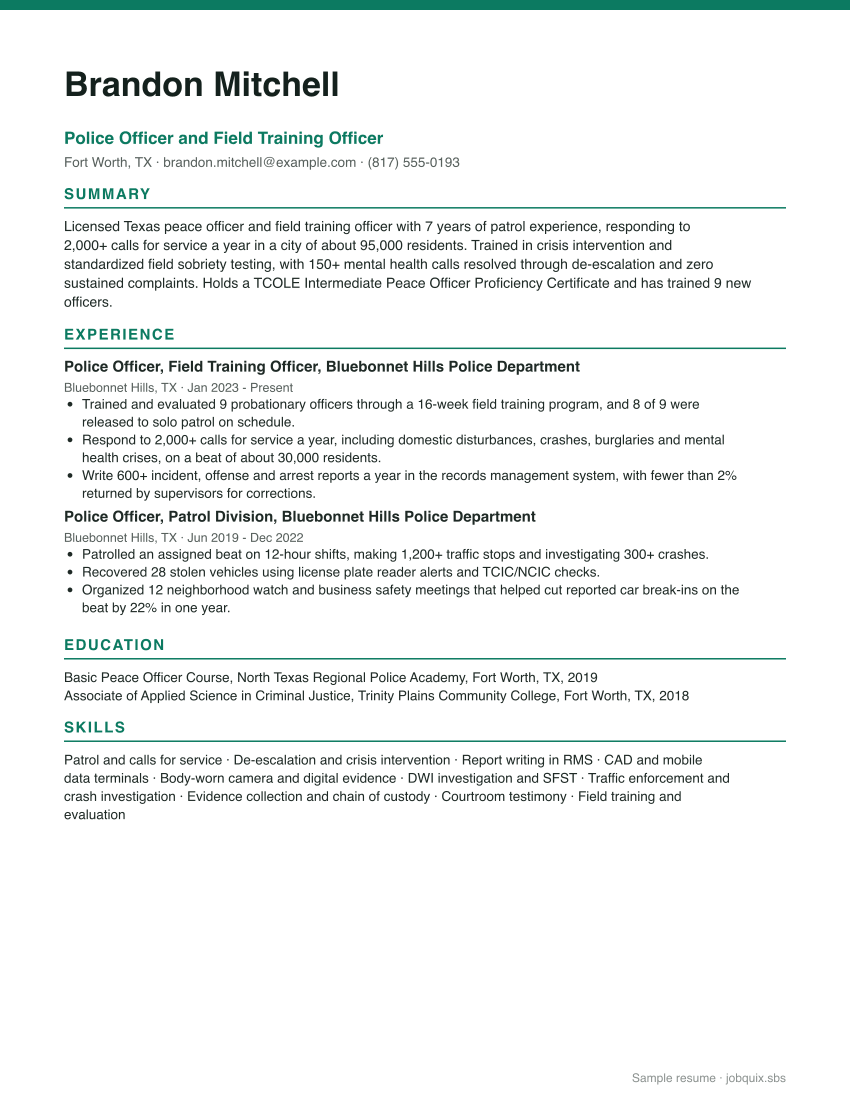
Police Officer resume summary examples
Academy graduate
Recent police academy graduate who passed the state licensing exam on the first attempt and finished in the top 5 of 38 cadets in firearms and defensive tactics. Brings 3 years as a hospital security officer, handling 20+ disturbance calls a month with verbal de-escalation. Bilingual in English and Spanish and ready for field training.
Experienced lateral
Patrol sergeant with 12 years of experience who supervises a squad of 10 officers on night shift. Cut squad overtime 15% with better call stacking and shift planning, and led the squad to the highest body-worn camera compliance score in the department. Holds advanced state certification and instructor credentials in de-escalation and firearms.
Military veteran
Army military police veteran with 6 years of law enforcement and security operations, including patrol, traffic enforcement and access control on an installation of 25,000 people. Wrote 400+ incident reports and trained 20 soldiers on use-of-force rules and radio procedures. Honorably discharged and ready for a police academy.
Need more ideas? See resume summary examples for every career stage.
Police Officer resume bullet points you can adapt
Strong bullets start with an action verb and end with a result. Swap in your own numbers.
- Responded to 2,000+ calls for service a year, including domestic disturbances, crashes, burglaries and mental health crises.
- Trained and evaluated 9 probationary officers through a 16-week field training program, with 8 of 9 released to solo patrol on schedule.
- Wrote 600+ incident and arrest reports a year with fewer than 2% returned by supervisors for corrections.
- Used crisis intervention skills on 150+ mental health calls and connected 60+ people with crisis services instead of jail.
- Conducted 40+ DWI investigations using NHTSA Standardized Field Sobriety Tests, with every case accepted for prosecution.
- Made 1,200+ traffic stops and investigated 300+ crashes while assigned to patrol.
- Recovered 28 stolen vehicles using license plate reader alerts and state and national crime database checks.
- Organized 12 neighborhood watch meetings that helped cut reported car break-ins on the beat by 22% in one year.
- Testified in 25+ court hearings with complete reports and evidence logs.
- Collected, packaged and logged evidence for 200+ cases with no chain of custody errors flagged by the property room.
- Met the department's body-worn camera compliance audit every quarter for 3 years.
- Served as acting corporal on 30+ shifts, assigning calls and backing up 6 officers.
- Taught 4 de-escalation scenario sessions to 40 officers during annual in-service training.
- Earned 2 lifesaving awards for CPR and tourniquet use at crash and shooting scenes.
Best skills for a police officer resume
| Hard skills | Soft skills |
|---|---|
| Patrol procedures | Sound judgment |
| De-escalation and crisis intervention | Calm under pressure |
| Report writing | Integrity |
| Records management and CAD systems | Clear communication |
| Body-worn camera and digital evidence | Empathy |
| DWI detection and SFST | Teamwork |
| Traffic enforcement | Leadership |
| Crash investigation | Cultural awareness |
| Evidence collection and chain of custody | |
| Firearms and defensive tactics | |
| Courtroom testimony | |
| First aid and tourniquet use |
Match these to the job posting before you apply. The ATS keyword checker shows which terms from a posting your resume is missing, and the skills guide covers how to list them.
Tips for writing a police officer resume
Lead with your license or academy status
States license or certify officers through a Peace Officer Standards and Training (POST) agency or a similar board, such as TCOLE in Texas. List your license, the agency and any proficiency certificates. If you are still in the academy or applying to one, list the academy and your expected completion date instead.
Use numbers from your calls, reports and training
Calls for service, reports written, arrests, crash investigations, officers trained and court appearances all show your workload. Use department reports or your own logs to get the numbers right. Avoid any figure you could not explain to a background investigator.
Show de-escalation and community work
Hiring boards want officers who can calm situations and build trust. Include crisis intervention training, mental health calls you resolved without force and community meetings you led. Give each one a number when you can.
List specialized training with hours
Crisis intervention, standardized field sobriety testing, field training officer, crash reconstruction and instructor courses help you stand out for specialty units and promotions. List the course name, hours and year. Keep the list to your most relevant training and offer the full transcript on request.
Keep it consistent with your application
Police hiring includes a detailed background investigation that checks your work history, dates and references. Make sure every date, title and claim on your resume matches your application and personal history packet. A mismatch can slow or end your application.
Protect privacy and case details
Never include names of victims, suspects or witnesses, or details from open cases. Describe your work by type and volume instead. Leave out anything your department policy treats as confidential.