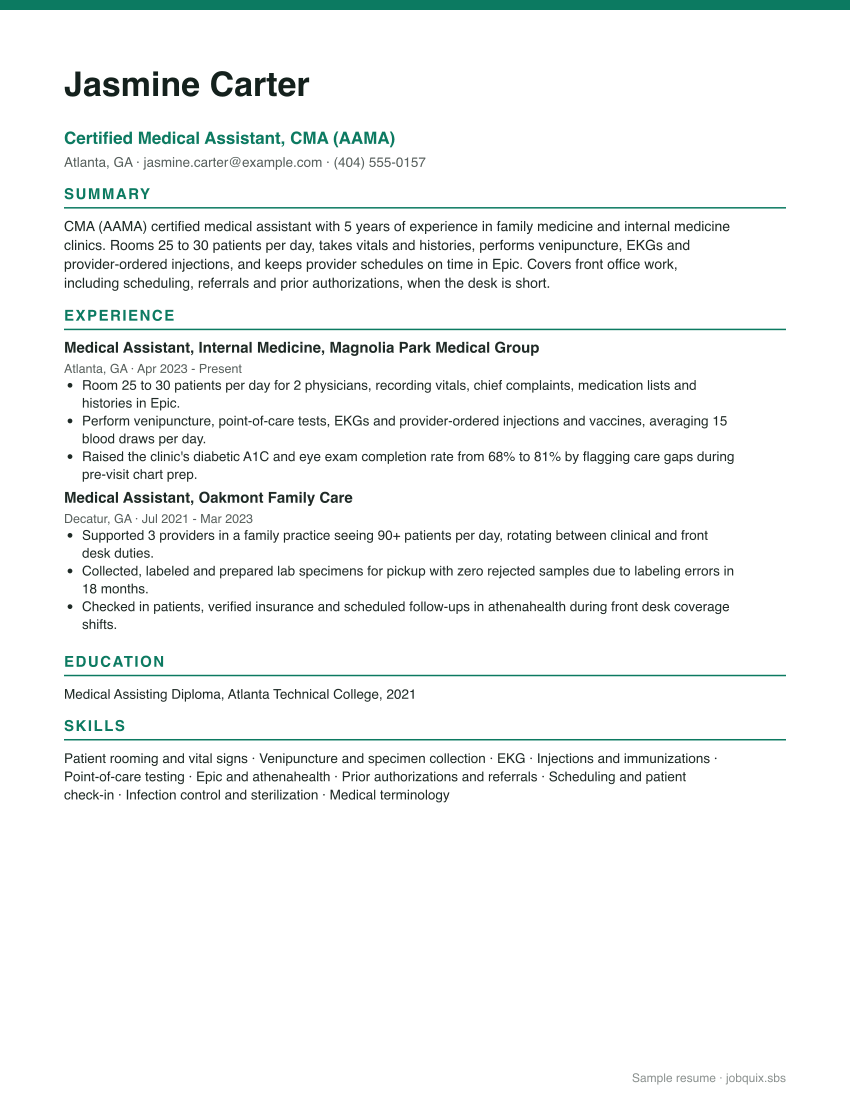
Medical Assistant resume summary examples
Entry level
Recent medical assisting graduate with a 160-hour externship in a busy pediatric clinic. Took vitals and histories for 20+ patients per shift, gave provider-ordered vaccines under supervision and scheduled follow-ups in eClinicalWorks. BLS certified and preparing for the CMA (AAMA) exam.
Experienced
Lead medical assistant with 9 years of experience in cardiology and multi-specialty clinics, supervising a team of 6 MAs. Performs EKGs, Holter monitor hookups and venipuncture, manages clinic supply ordering and built a rooming checklist that cut visit delays by 20%. RMA (AMT) certified.
Career changer
Former pharmacy technician moving into medical assisting, with 4 years of experience with medication names, insurance processing and patient communication. Completed a medical assisting program with a 160-hour externship and earned the RMA (AMT) credential. Brings accuracy, calm patient service and strong HIPAA privacy habits.
Need more ideas? See resume summary examples for every career stage.
Medical Assistant resume bullet points you can adapt
Strong bullets start with an action verb and end with a result. Swap in your own numbers.
- Roomed 25 to 30 patients per day, recording vitals, histories and medication lists in Epic.
- Performed an average of 15 venipunctures per day with a first-stick success rate above 95%.
- Completed 10+ EKGs per day and routed tracings to providers for same-day review.
- Gave provider-ordered injections and vaccines to 40+ patients per week, documenting lot numbers and sites accurately.
- Raised diabetic screening completion from 68% to 81% by flagging care gaps during pre-visit chart prep.
- Cut average referral turnaround from 6 business days to 3 by submitting referrals within 24 hours of the order.
- Submitted 20+ prior authorizations per week and tracked each one through approval or denial.
- Kept 2 providers on schedule, reducing average patient wait time from 22 minutes to 14.
- Collected and labeled lab specimens with zero rejections for labeling errors in 18 months.
- Covered the front desk 2 days per week, checking in 40+ patients and verifying insurance in athenahealth.
- Trained 5 new medical assistants on rooming, charting and infection control procedures.
- Managed clinical supply ordering for 6 exam rooms, cutting rush orders by 40% with par levels.
- Cleaned exam rooms and sterilized instruments per clinic protocol, with no findings in quarterly infection control audits.
- Called 30+ patients per day with provider-approved lab results and instructions, and scheduled follow-up visits.
Best skills for a medical assistant resume
| Hard skills | Soft skills |
|---|---|
| Vital signs and patient intake | Patient communication |
| Venipuncture and capillary sticks | Compassion |
| EKG | Multitasking |
| Injections and immunizations | Attention to detail |
| Point-of-care testing | Teamwork |
| Specimen collection and processing | Calm under pressure |
| EHR charting (Epic, athenahealth, eClinicalWorks) | Time management |
| Scheduling and patient check-in | |
| Prior authorizations and referrals | |
| Infection control and sterilization | |
| Medical terminology | |
| HIPAA privacy practices |
Match these to the job posting before you apply. The ATS keyword checker shows which terms from a posting your resume is missing, and the skills guide covers how to list them.
Tips for writing a medical assistant resume
Show both clinical and administrative skills
Many medical assistant jobs mix back office and front office work. Include bullets for both: rooming, vitals, injections and EKGs on the clinical side, and scheduling, insurance and referrals on the administrative side. If a posting stresses one side, put those bullets first.
Write your credential the official way
Use the format the certifying body uses, such as CMA (AAMA) from the American Association of Medical Assistants or RMA (AMT) from American Medical Technologists. Add BLS with the issuing organization. Put your credential in your headline and again in a certifications section.
Describe clinical tasks within your scope
What a medical assistant may do varies by state and employer. Phrase clinical work accurately, such as 'administered provider-ordered vaccines', rather than suggesting you made clinical decisions. If you are unsure about a task, check your state's rules or ask your practice manager.
Use patient volume and quality numbers
Give daily patient counts, procedures per day and results like shorter wait times, faster referrals or higher screening rates. These numbers show a practice manager how you would affect their schedule.
Name your specialty and EHR
Family medicine, pediatrics, cardiology and dermatology use different procedures. Name your specialties and the EHR you charted in, such as Epic, athenahealth or eClinicalWorks, so reviewers can see you will need less training.
Keep your certification current
The CMA (AAMA) must be recertified every 60 months, by continuing education or by exam, and other credentials have their own renewal cycles. List only active credentials, and include the expiration date if an employer asks for it.