Executive resume summary examples
First executive role
Senior director of operations with 14 years of experience, ready for a vice president role. Runs 3 plants with 640 employees and a $95M cost budget, and led a footprint consolidation that saved $6M a year with no disruption to customer service levels. Partners with finance, sales and HR on annual planning and has presented to the board 4 times.
Experienced executive
Chief operating officer with 22 years of leadership in consumer goods and logistics, most recently accountable for a $1.1B P&L and 4,000 employees in 3 countries. Led the operating model redesign that supported growth from $640M to $1.1B in revenue over 5 years while improving EBITDA margin by 3.5 points. Experienced partner to private equity boards on value creation plans and exits.
Career changer
Retired U.S. Army colonel moving into civilian operations leadership after 24 years leading logistics organizations of up to 2,800 people with a $310M annual budget. Directed supply operations across 4 countries and closed equipment readiness gaps by 30% with a new maintenance planning system. Holds an MBA and the PMP certification.
Need more ideas? See resume summary examples for every career stage.
Executive resume bullet points you can adapt
Strong bullets start with an action verb and end with a result. Swap in your own numbers.
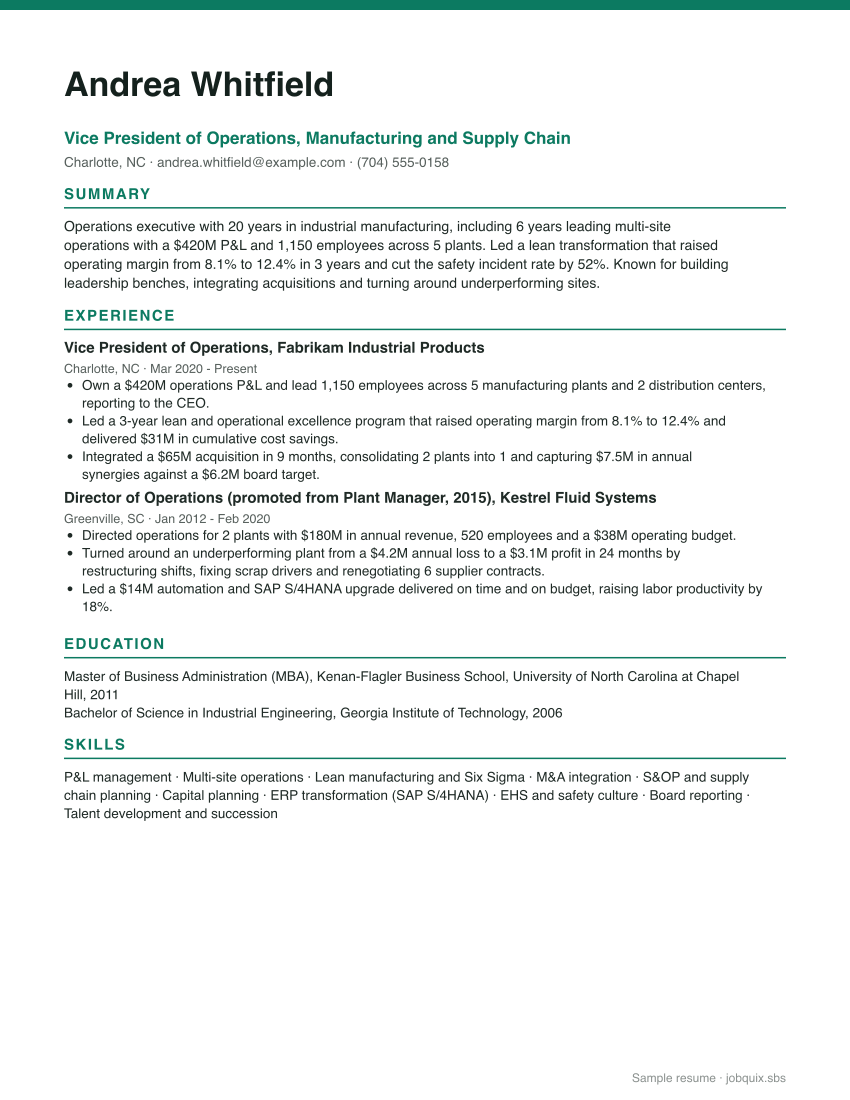
- Owned a $420M operations P&L across 5 plants and 2 distribution centers with 1,150 employees.
- Raised operating margin from 8.1% to 12.4% in 3 years through a company-wide lean transformation.
- Delivered $31M in cumulative cost savings by standardizing processes, procurement and maintenance across sites.
- Integrated a $65M acquisition in 9 months, capturing $7.5M in annual synergies against a $6.2M target.
- Turned a plant from a $4.2M annual loss to a $3.1M profit within 24 months.
- Cut the OSHA recordable incident rate by 52% with plant safety leadership teams and near-miss reporting.
- Improved on-time, in-full delivery from 81% to 96%, helping grow revenue with the top 10 accounts by 14%.
- Released $11M in working capital by reducing inventory while raising fill rate to 97%.
- Led a $14M ERP and automation program delivered on time and on budget, lifting labor productivity by 18%.
- Reduced salaried turnover from 19% to 9% by building a leadership academy and succession plans for 40 key roles.
- Presented quarterly operating reviews to the board of directors and led operations due diligence for a $250M refinancing.
- Negotiated a 4-year collective bargaining agreement with no work stoppage.
- Consolidated 3 warehouses into 1 regional distribution center, saving $4.8M a year in lease and freight cost.
- Built a 5-year, $85M capital plan and raised the average return on capital projects from 11% to 17%.
Best skills for an executive resume
| Hard skills | Soft skills |
|---|---|
| P&L ownership | Executive presence |
| Strategic planning | Decision-making |
| Operational excellence (Lean, Six Sigma) | Change leadership |
| M&A due diligence and integration | Coaching and talent development |
| Budgeting and capital allocation | Cross-functional influence |
| Supply chain and S&OP | Accountability |
| ERP transformation | Negotiation |
| KPI and performance management | Clear communication |
| Board and investor communication | |
| EHS and risk management | |
| Labor relations | |
| Organizational design |
Match these to the job posting before you apply. The ATS keyword checker shows which terms from a posting your resume is missing, and the skills guide covers how to list them.
Tips for writing an executive resume
Lead with scope in every role
Executive recruiters look first for scope: P&L size, budget, headcount, number of sites and who you reported to. Put those facts in the first bullet of each role so they are seen in seconds. A line like 'own a $420M P&L and 1,150 employees across 5 plants' does more than any adjective.
Write the summary like a business case
Your summary should answer three questions: what you lead, at what scale and what changed because of you. Use 3 or 4 sentences with 2 headline results, such as margin, revenue or cost. Skip phrases like 'results-driven leader' that every executive resume uses.
Show transformation with before and after numbers
Boards hire executives to change something, so show the starting point and the result, such as margin from 8.1% to 12.4% or a plant from loss to profit. Add the timeframe to show pace. Use verbs like 'led' and 'directed' so your team gets fair credit.
Use two pages and summarize early career
Most executive resumes run two pages, with the most recent 10 to 15 years in full detail. Summarize earlier roles in an Early Career line with titles and employers but no bullets. Make page one strong enough to stand on its own.
Include board-level and governance work
Board presentations, lender or investor reviews, M&A deals and nonprofit board seats all signal executive readiness. Give each a number where you can, such as deal size or capital raised. Never share confidential deal terms or nonpublic financials from a current or past employer.
Tailor the top third for each search
Executive searches are specific: a private equity portfolio company wants value creation, while a public company may want scale and governance. Adjust your headline, summary and first bullets to match the role. Keep a master resume with every achievement so tailoring takes minutes.