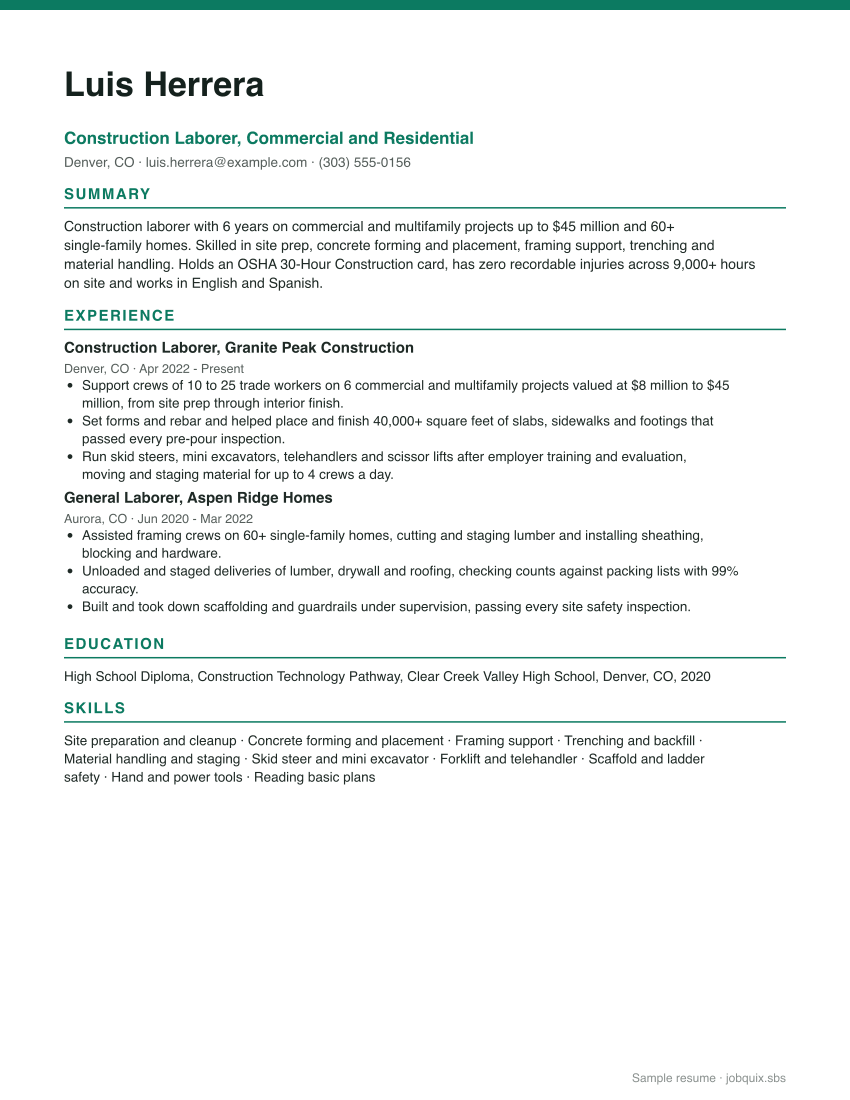
Construction Worker resume summary examples
Entry level
Hardworking entry-level laborer with OSHA 10-Hour Construction training and NCCER Core completed through a high school construction program. Built 2 storage sheds and a wheelchair ramp in class and volunteered on 3 community home repair projects. Has a valid driver's license, reliable transportation and is available for early starts and overtime.
Experienced
Lead laborer with 10 years of commercial construction experience and an OSHA 30 card, directing crews of up to 8 laborers on concrete, excavation and site work. Trained as a competent person for excavations and scaffolds, with zero lost-time injuries on crews under my lead. Comfortable reading plans and coordinating with superintendents and trade foremen.
Career changer
Former warehouse associate moving into construction with 4 years of forklift and reach truck experience and a perfect safety record. Used to physical work, early starts and tight deadlines, and completed OSHA 10-Hour Construction training. Ready to learn from experienced crews and work toward an apprenticeship in a skilled trade.
Need more ideas? See resume summary examples for every career stage.
Construction Worker resume bullet points you can adapt
Strong bullets start with an action verb and end with a result. Swap in your own numbers.
- Supported crews of 10 to 25 trade workers on 6 commercial and multifamily projects valued up to $45 million.
- Set forms and rebar and helped place 40,000+ square feet of slabs, sidewalks and footings that passed every pre-pour inspection.
- Ran skid steers, mini excavators, telehandlers and scissor lifts after employer training, moving material for up to 4 crews a day.
- Dug and backfilled 1,200+ linear feet of utility trench, setting trench boxes under the direction of the competent person.
- Assisted framing crews on 60+ single-family homes, cutting and staging lumber and installing sheathing and blocking.
- Unloaded and staged deliveries of lumber, drywall and roofing with 99% count accuracy against packing lists.
- Built and dismantled scaffolding and guardrail systems under supervision, passing every site safety inspection.
- Led daily toolbox talks in English and Spanish and enforced PPE and fall protection rules, with zero recordable injuries in 4 years.
- Worked 9,000+ hours on active job sites without a recordable injury.
- Signaled crane and equipment operators during material picks using standard hand signals and radio calls.
- Sorted job site waste for recycling, helping a project divert 75% of waste from landfill.
- Flagged traffic on 20+ road and utility jobs, keeping work zones safe for crews and drivers.
- Cut and installed 3,000+ feet of silt fence and inlet protection to meet the project's stormwater plan.
- Kept 4 to 6 active home sites clean and organized each week, cutting time lost to searching for tools and material.
Best skills for a construction worker resume
| Hard skills | Soft skills |
|---|---|
| Site preparation and cleanup | Safety focus |
| Concrete forming, placing and finishing | Physical stamina |
| Framing support | Reliability |
| Trenching and backfill | Teamwork |
| Material handling and staging | Following directions |
| Skid steer and mini excavator operation | Willingness to learn |
| Forklift and telehandler operation | Communication |
| Scaffold erection support | |
| Fall protection and PPE | |
| Hand and power tools | |
| Reading basic plans and layouts | |
| Equipment signaling |
Match these to the job posting before you apply. The ATS keyword checker shows which terms from a posting your resume is missing, and the skills guide covers how to list them.
Tips for writing a construction worker resume
List safety training first
Put your OSHA 10-Hour or 30-Hour Construction card near the top. OSHA describes these cards as proof of completing hazard awareness training, not a certification or license, so write them as 'OSHA 30-Hour Construction Outreach Training (DOL card).' Add first aid, CPR, fall protection or flagger training if you have it.
Name the equipment you can run
List each piece of equipment, such as skid steer, mini excavator, telehandler, forklift or aerial lift, and how you were trained. OSHA requires each employer to certify that its forklift operators have been trained and evaluated, so past training shows experience but a new employer will still evaluate you. Never list equipment you cannot run safely.
Show project types and sizes
Commercial, multifamily, residential, road and utility work each use different skills. Name the project types and, when you know them, the size in square feet, homes or dollars. A superintendent can then picture where you fit on their site.
Use job site numbers
Square feet of concrete, linear feet of trench, homes framed, crew size and hours without an injury all show what you can do. Pick numbers you can explain in an interview. If you do not know an exact figure, use a careful estimate with a plus sign, like '60+ homes.'
Mention your license, transportation and tools
Many job sites start early and move around town, so a valid driver's license and reliable transportation help. If you own a basic set of hand tools, say so. Add languages you speak on the job, since bilingual workers can help a crew communicate.
Keep it short and easy to read
A one-page resume with a short summary, 2 or 3 jobs, certifications and skills is enough. Use plain formatting that reads well on a phone or a printed copy. List your most recent job first.