Electrician resume summary examples
Apprentice
Licensed electrical apprentice in year 2 of a 4-year program, with 3,000+ field hours in residential new construction and service work. Comfortable with rough-in, trim-out, conduit bending and reading house plans, and on track to meet journeyman licensing hours. OSHA 10 trained, reliable and quick to learn from senior electricians.
Experienced
Master electrician with 15 years of commercial and industrial experience who pulls permits, estimates jobs and leads crews of up to 12. Delivered electrical scopes of up to $2 million on time and within budget, including medical office and school projects. Strong in load calculations, code compliance, inspections and mentoring apprentices toward licensing.
Industrial maintenance
Maintenance electrician with 8 years in manufacturing plants, troubleshooting motors, VFDs, PLC-controlled equipment and 480-volt distribution. Cut unplanned downtime on 3 packaging lines by 18% through infrared scans and a preventive maintenance schedule. Works safely under NFPA 70E and the plant's lockout/tagout program.
Need more ideas? See resume summary examples for every career stage.
Electrician resume bullet points you can adapt
Strong bullets start with an action verb and end with a result. Swap in your own numbers.
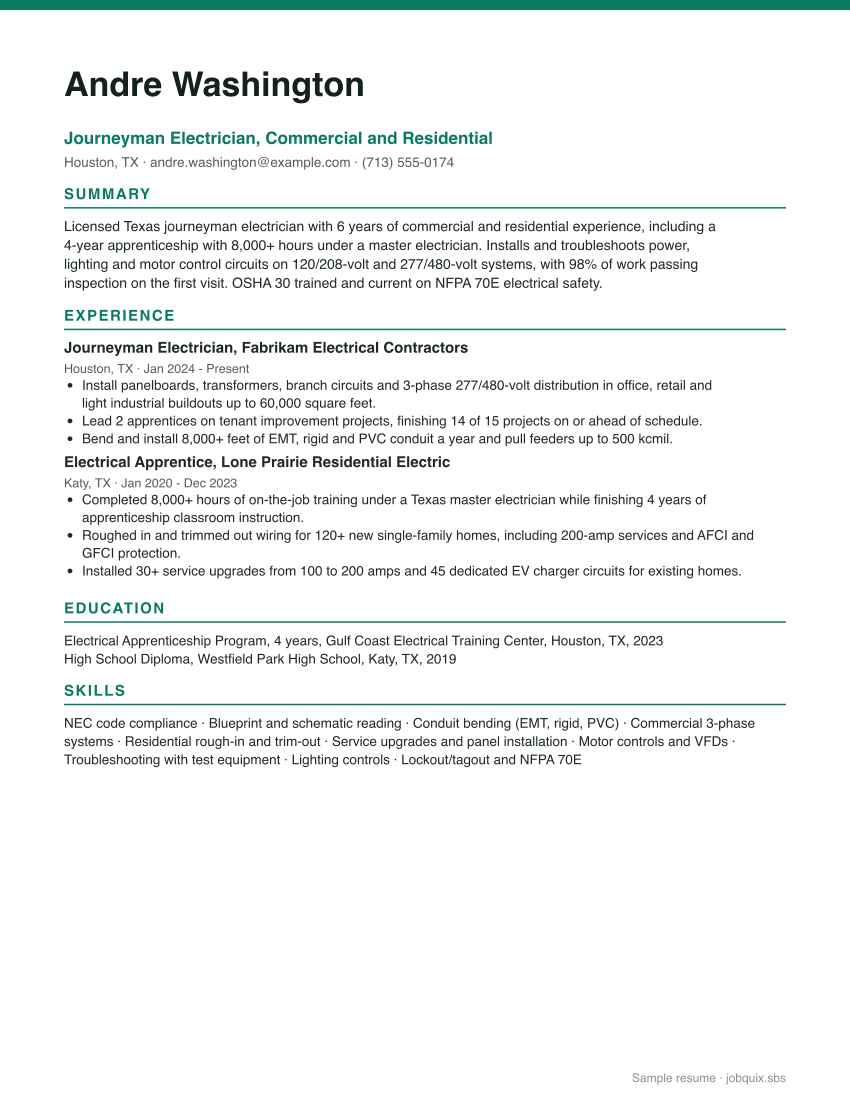
- Installed panelboards, transformers and 3-phase 277/480-volt distribution in commercial buildouts up to 60,000 square feet.
- Passed 98% of rough-in and final inspections on the first visit by working to the adopted NEC and local amendments.
- Bent and installed 8,000+ feet of EMT, rigid and PVC conduit a year and pulled feeders up to 500 kcmil.
- Troubleshot motor controls, VFDs and lighting control circuits, cutting average service call time from 4 hours to 3.
- Led 2 apprentices on tenant improvement projects, finishing 14 of 15 projects on or ahead of schedule.
- Roughed in and trimmed out wiring for 120+ new homes, including 200-amp services and AFCI and GFCI protection.
- Installed 30+ residential service upgrades from 100 to 200 amps and 45 dedicated EV charger circuits.
- Built material lists from plans for each job, cutting wire and device overages by about 10%.
- Followed lockout/tagout and NFPA 70E procedures on every job, with zero electrical incidents in 3 years.
- Ran insulation resistance and continuity tests on new feeders and documented results for the general contractor's closeout package.
- Cut unplanned downtime on 3 production lines by 18% with infrared scans and a preventive maintenance schedule.
- Replaced and programmed 20+ VFDs on pumps and conveyors with no production delays at startup.
- Completed 8,000+ hours of on-the-job training under a master electrician during a 4-year apprenticeship.
- Trained 5 apprentices on conduit bending, plan reading and safe work practices.
Best skills for an electrician resume
| Hard skills | Soft skills |
|---|---|
| National Electrical Code (NEC) | Safety focus |
| Blueprint and schematic reading | Problem solving |
| Conduit bending and installation | Attention to detail |
| Commercial 3-phase power distribution | Reliability |
| Residential wiring and service upgrades | Teamwork with other trades |
| Panelboard and transformer installation | Clear communication |
| Motor controls and VFDs | Mentoring |
| Lighting and lighting control systems | Time management |
| Troubleshooting with multimeters and megohmmeters | |
| Lockout/tagout | |
| NFPA 70E arc flash safety | |
| Load calculations |
Match these to the job posting before you apply. The ATS keyword checker shows which terms from a posting your resume is missing, and the skills guide covers how to list them.
Tips for writing an electrician resume
Put your license and state at the top
Electrician licensing is set by each state, and some cities have their own rules. List your license level, such as apprentice, journeyman or master, with the issuing agency and state. For example, Texas journeyman applicants need 8,000 hours of on-the-job training under a master electrician and a passed exam, so 'Journeyman Electrician License, TDLR' tells a Texas contractor exactly where you stand.
Name your systems, voltages and project types
Residential, commercial and industrial work use different skills. Say what you install and service, such as 3-phase 277/480-volt distribution, motor controls or 200-amp residential services. Add building types and sizes so a contractor can match you to their jobs.
Show code and inspection results
A first-time inspection pass rate is one of the clearest ways to show quality work. Mention that you work to the NEC and local amendments, and add any code update classes you have taken. Keep the number honest and easy to explain.
Make safety visible
List OSHA 10 or 30 training, NFPA 70E electrical safety training and lockout/tagout experience. A line like 'zero electrical incidents in 3 years' backs it up. Contractors and plant managers look for safe habits as much as skill.
Apprentices: track your hours
Many states set journeyman eligibility by documented on-the-job hours, so show your hours and classroom years. List the types of work you have done, such as rough-in, trim-out, service upgrades and conduit runs. This shows how close you are to journeyman level.
List your tools and test equipment
Name test equipment like multimeters, clamp meters and insulation resistance testers, plus benders, wire pullers and lifts you can run. These terms often appear in job postings. They also help a foreman know what you can do on day one.