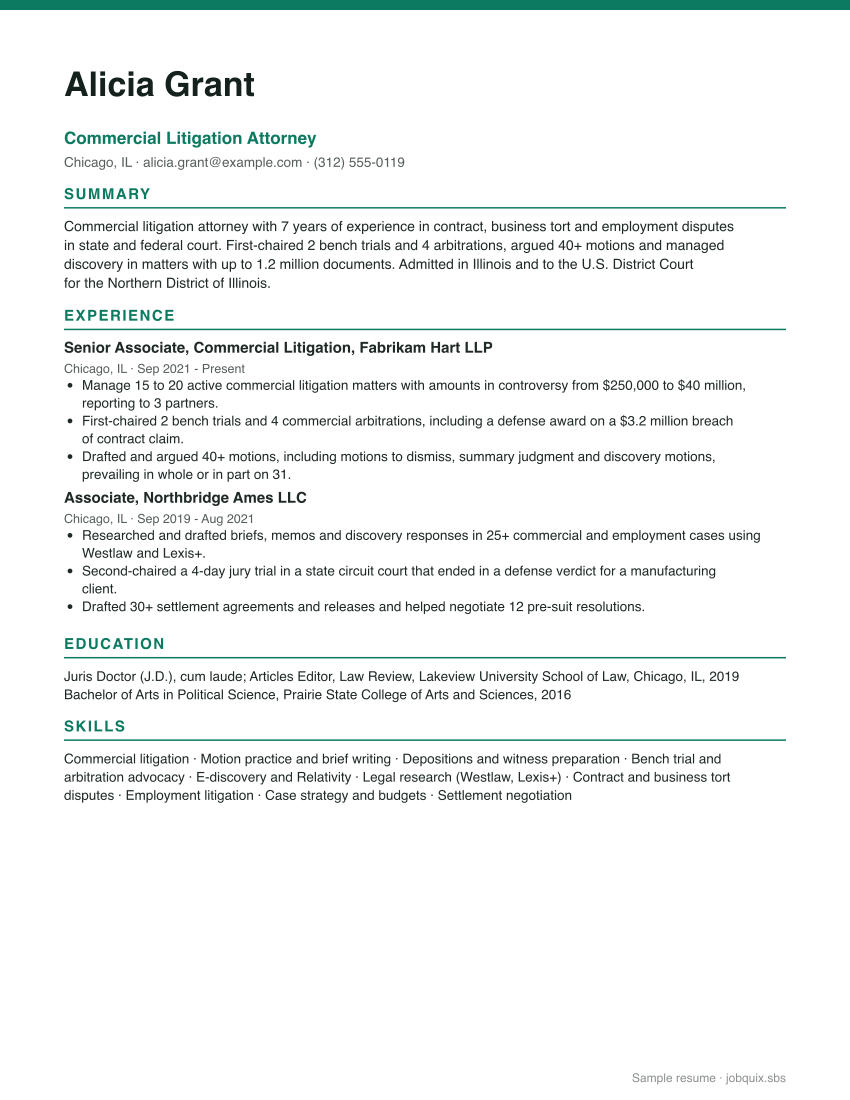
Attorney resume summary examples
New attorney
Licensed attorney and 2025 J.D. graduate with 2 summer associate positions in commercial litigation and a judicial externship with a federal magistrate judge. Drafted bench memos on 20+ civil motions and served as articles editor of the law review. Brings strong research, writing and citation skills to a first-year associate role.
Experienced transactional
Corporate attorney with 10 years of M&A and commercial contracts experience, closing 45+ transactions valued from $5 million to $600 million. Leads diligence teams, drafts purchase agreements and disclosure schedules and advises management on deal structure and risk allocation. Admitted in New York and Illinois.
Moving in-house
Litigation attorney moving in-house after 8 years at a law firm, with deep experience in employment and commercial disputes. Counseled HR and business leaders at 20+ corporate clients on policies, investigations and contract terms, and built a litigation hold process now used firm-wide. Practical, fast and focused on business outcomes.
Need more ideas? See resume summary examples for every career stage.
Attorney resume bullet points you can adapt
Strong bullets start with an action verb and end with a result. Swap in your own numbers.
- Managed 15 to 20 active commercial litigation matters with amounts in controversy up to $40 million.
- First-chaired 2 bench trials and 4 commercial arbitrations, including a defense award on a $3.2 million claim.
- Drafted and argued 40+ dispositive and discovery motions, prevailing in whole or in part on 31.
- Took or defended 60+ depositions, including expert and corporate representative witnesses.
- Led e-discovery for a 1.2 million document production in Relativity, supervising 8 contract attorneys and cutting review hours by about 30% with technology-assisted review.
- Second-chaired a 4-day jury trial that ended in a defense verdict.
- Wrote the appellate brief in a contract dispute that the court of appeals affirmed in full.
- Negotiated 12 pre-suit settlements, avoiding litigation costs for clients in each matter.
- Closed 45+ M&A transactions valued from $5 million to $600 million, leading diligence teams of up to 6 lawyers.
- Drafted and negotiated 200+ commercial agreements a year, including supply, licensing and services contracts.
- Built a litigation hold checklist and tracking process that the firm adopted for all new matters.
- Billed an average of 1,950 hours a year with consistent on-budget delivery on fixed-fee matters.
- Mentored 3 junior associates on research, brief writing and deposition preparation.
- Handled 10 pro bono housing matters, keeping 8 families in their homes.
Best skills for an attorney resume
| Hard skills | Soft skills |
|---|---|
| Litigation and trial practice | Persuasive writing |
| Motion practice and brief writing | Oral advocacy |
| Depositions | Judgment |
| Arbitration and mediation | Attention to detail |
| E-discovery and technology-assisted review | Client service |
| Legal research (Westlaw, Lexis+) | Negotiation |
| Contract drafting and negotiation | Composure under deadlines |
| Due diligence | Mentoring |
| Appellate writing | |
| Federal and state court procedure | |
| Litigation holds and document preservation | |
| Case budgets and billing |
Match these to the job posting before you apply. The ATS keyword checker shows which terms from a posting your resume is missing, and the skills guide covers how to list them.
Tips for writing an attorney resume
Give bar admissions their own section
List each state where you are admitted with the year, then any federal district and appellate courts. Federal court admission is separate from state bar admission, so list it only if you have been admitted. If you are waiting on results, write 'Bar admission pending, Illinois, July 2026 exam.'
Describe matters without naming clients
Lawyers owe clients a duty of confidentiality, set out in ABA Model Rule 1.6 and each state's version of it. Describe matters by type, court and size, such as 'breach of contract claim of $3.2 million,' instead of naming the client. Check your firm's policy and your state's rules before mentioning any client by name, even in a public case.
Quantify your practice
Numbers like docket size, motions argued, depositions taken, trials and arbitrations, document volume and deal values show your level quickly. Hiring partners compare candidates by experience, so make yours easy to count. Use 'first-chaired' and 'second-chaired' accurately.
Match the practice area
Litigators and transactional lawyers are hired for different skills. Lead with the experience that matches the role, and move unrelated work lower or into a short 'Other experience' line. Use the terms from the job posting, such as 'commercial contracts' or 'employment litigation.'
Junior lawyers: put education near the top
For your first few years, your law school, honors, law review or journal, moot court and clerkships carry a lot of weight. Put education above experience until your legal work is the stronger section. Include class rank only if it helps you.
Keep it tight and add a matters list if needed
One page works for junior lawyers and two pages for experienced attorneys. If you have many significant matters or deals, move them to a separate representative matters list instead of crowding the resume. Proofread every citation and date, since writing quality is part of what you are selling.