1. Blush peony cushion with pearl buds
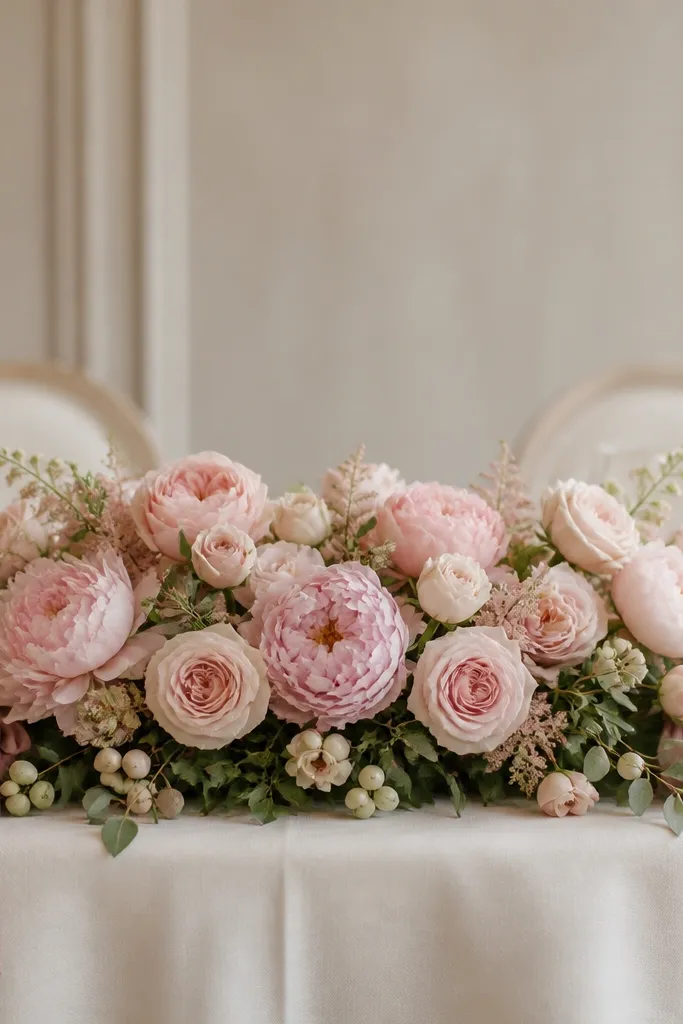
This setup is for when you want "soft romance" without looking frilly. I use blush garden roses as the main flower, then add peonies in the same warm pink family so the petals look full even in indoor lighting. The creamy mini buds give tiny highlights that read like jewelry in close-up photos. Seeded eucalyptus and ruscus keep the palette cohesive and add movement at the edges. It flatters fair to medium skin tones beautifully because the pinks stay warm, not icy.
Start by laying a flat grid base across the table - I like a chicken wire panel stretched tightly over a shallow liner. Then place the blush roses first as a horizontal cushion, spacing them about 2-3 inches apart. Add peonies in the gaps, aiming for a gentle mound at the center that stays under 16 inches tall. Finally, tuck the creamy buds along the front edge and finish with small ribbon ties at both corners so the greenery doesn't look "dropped."
Try thisSpray the eucalyptus lightly with water before styling - it holds shape better and looks fuller on camera.
Common mistakeAvoid mixing cool-toned mauves with warm blush unless you test it under your venue lighting.
2. Ivory ranunculus and freesia with lemon accents
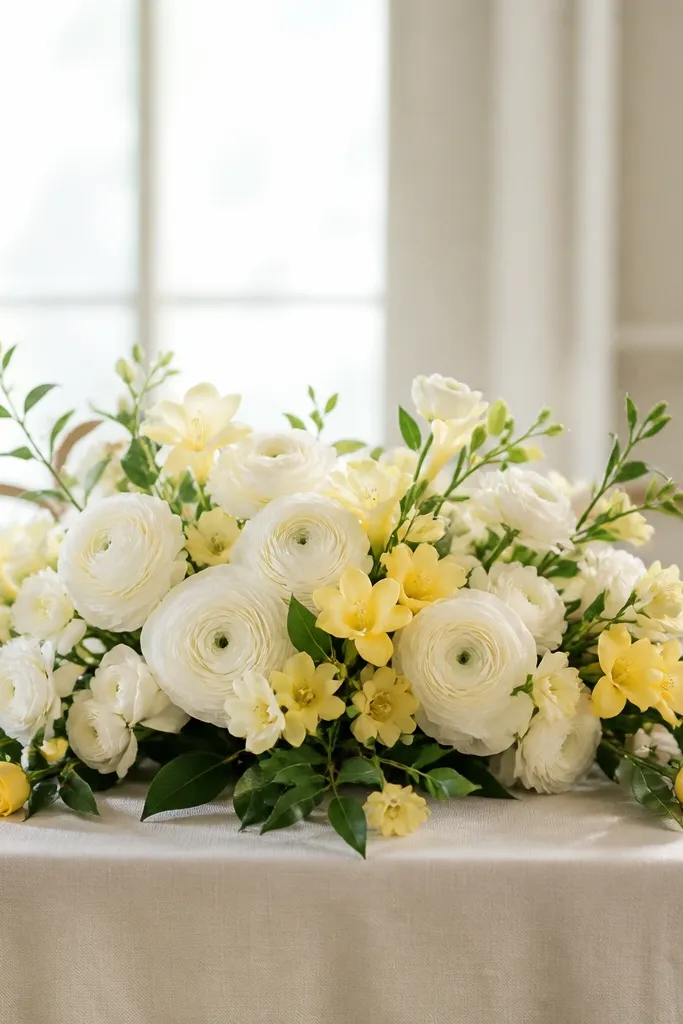
This one is crisp, clean, and great for spring or a citrusy color palette. Ivory ranunculus gives you that tight petal texture that reads sharp in photos. Freesia adds a delicate, airy look, and the lemon accents keep the arrangement from feeling too bridal-ivory and flat. I pair glossy greens like Italian ruscus so the table still looks fresh from a distance. This works especially well if your linens are white or cream with a satin finish, because the flowers add contrast without turning the table yellow.
Begin by separating your stems into three bundles: ranunculus, freesia, and greens. Build the base with ruscus first, then tuck ranunculus clusters across the center in a slightly staggered pattern for fullness. Add freesia in small drifts - don't scatter it everywhere, or it gets wispy and disappears. Finish by placing lemon-yellow buds only at the outer third of the arrangement so the focal points stay near the couple.
Try thisCut freesia stems at an angle right before arranging so they open and look alive instead of droopy.
Common mistakeDon't use too many different yellow shades; one lemon tone is enough.
3. Tangerine dahlias with black-eyed Susan edges
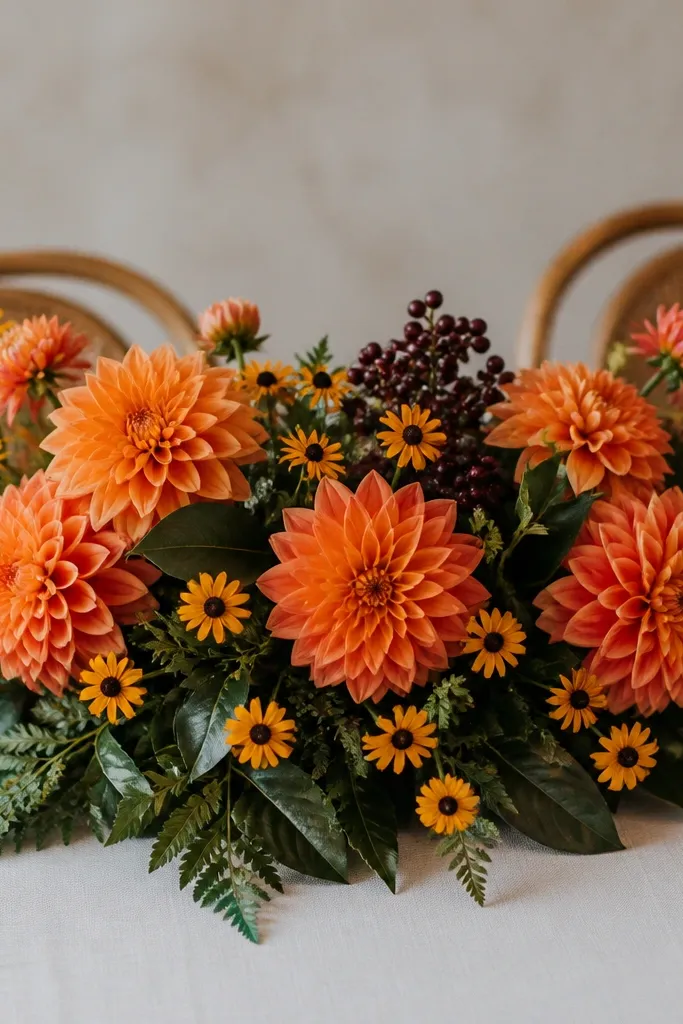
If you want your sweetheart table to look bold and not like every other wedding, this is it. Tangerine dahlias bring strong shape - the petals are structured and look graphic from the aisle. Black-eyed Susan adds a sunny, slightly wild edge that feels intentional rather than messy when kept in small doses. I anchor everything with deep green foliage so the orange pops without turning clownish. This flatters warm undertones and looks amazing with gold flatware and amber candleholders.
Start with a low base using dense greens so the orange flowers don't sink. Place dahlias first, spacing them evenly across the center line, then fill gaps with smaller orange blossoms or extra dahlias if you have them. Tuck black-eyed Susan along the outer rim like a "frame," not across the whole front. Add a few maroon berry sprigs behind the main cluster for depth, then stop - too many berries make it look like a fall potpourri stand.
Try thisKeep the dahlias slightly tilted toward the center so both bride and groom faces catch the light.
Common mistakeAvoid thin, feathery fillers that fight the bold dahlia shape.
4. Rosemary, white roses, and olive drape across the front
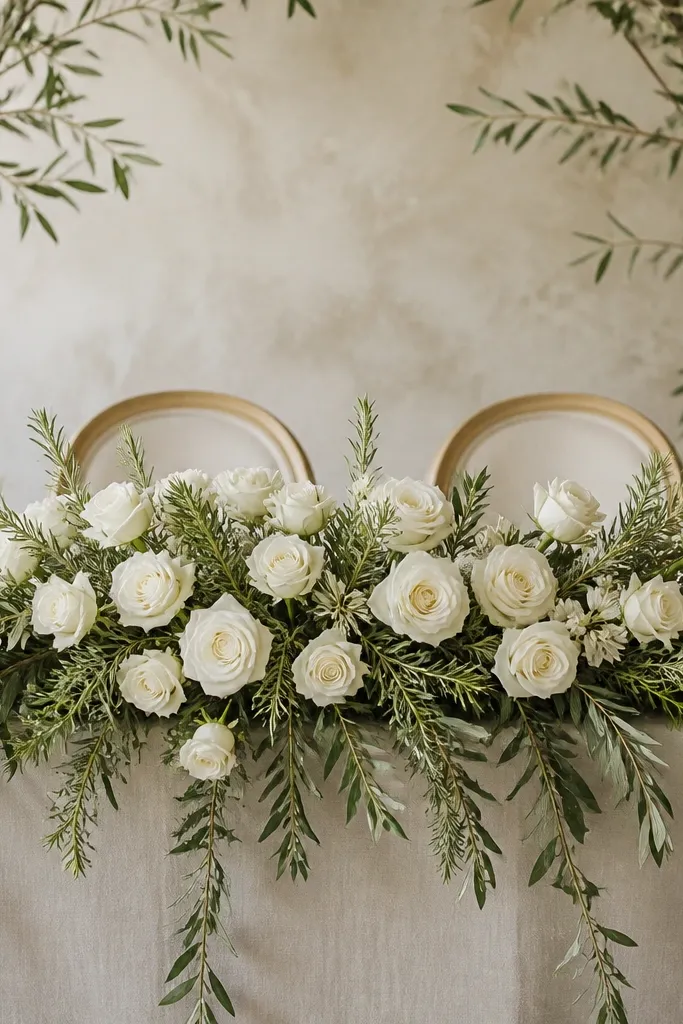
This is my go-to when the venue has lots of natural wood or a Mediterranean vibe. White roses look classic, while rosemary adds that piney texture that reads fresh and expensive. The olive drape gives you motion without height - it hangs low like a curtain over the front edge. I keep the palette mostly white and green with only one soft accent, like a pale blush rose, so it doesn't look busy. It looks great on darker tablecloths too because the greens still show depth.
Begin by wiring a shallow "ledge" across the table so draping stems have somewhere to rest. Place white roses in a horizontal line, then weave rosemary in between them like a scented lattice. Add olive leaves in longer lengths and let them fall over the front edge by 2-3 inches. Finish with olive branches at both corners, trimmed so the outer leaves stop at the table legs.
Try thisUse fresh rosemary, not dried - dried rosemary turns gray and looks dusty by dinner.
Common mistakeDon't let the drape hit the place cards; keep it behind the seat markers.
5. Champagne roses with dusty plum berries
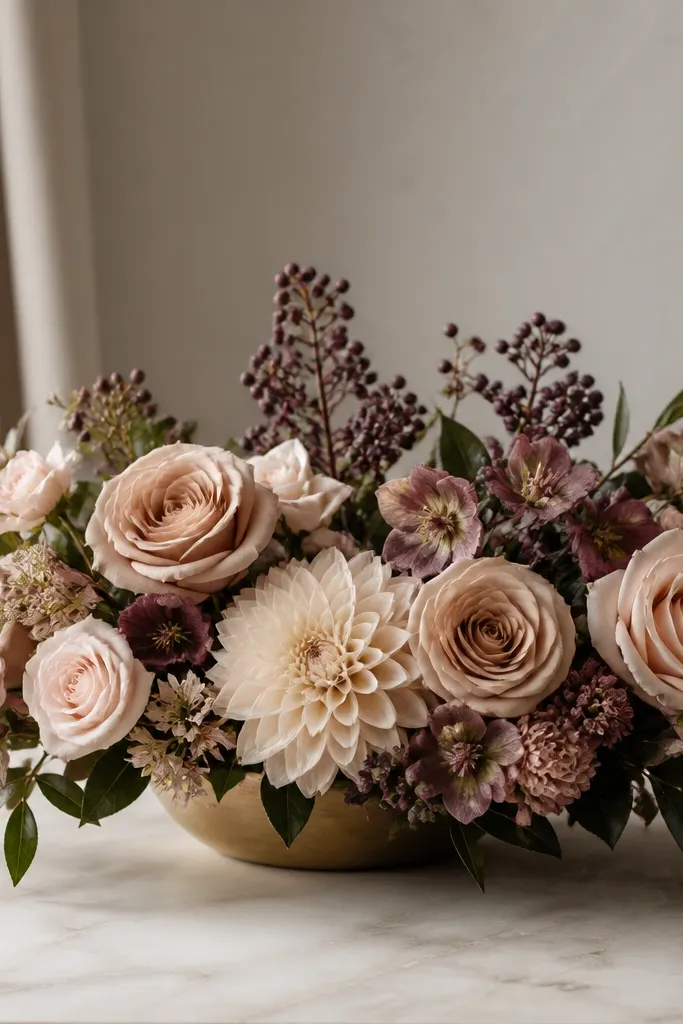
This color mix makes sweetheart table wedding flowers look grown-up, especially for fall and winter. Champagne roses are warmer than pure white, so they flatter medium and deeper skin tones without washing anyone out. Dusty plum berries add contrast without going full purple - the berries look like little ornaments. I use dark green leaves to hold the contrast and keep the arrangement from looking airy. If your table has burgundy napkins or a dark runner, this palette ties it together without clashing.
Start by building a dark-green base using ruscus or seeded eucalyptus, keeping it low and dense. Place champagne roses as your main "islands," then tuck plum berries behind the front row so they peek out. Add a few small taupe filler flowers only in the center so the berries stay the second focal point. Trim the outer leaves so nothing extends past the table edge line.
Try thisIf berries shed, mist them lightly and keep them toward the back - less handling means less mess.
Common mistakeAvoid placing berries in the front edge; they can look like random sprinkles instead of intentional depth.
6. White hydrangea and green apple accents
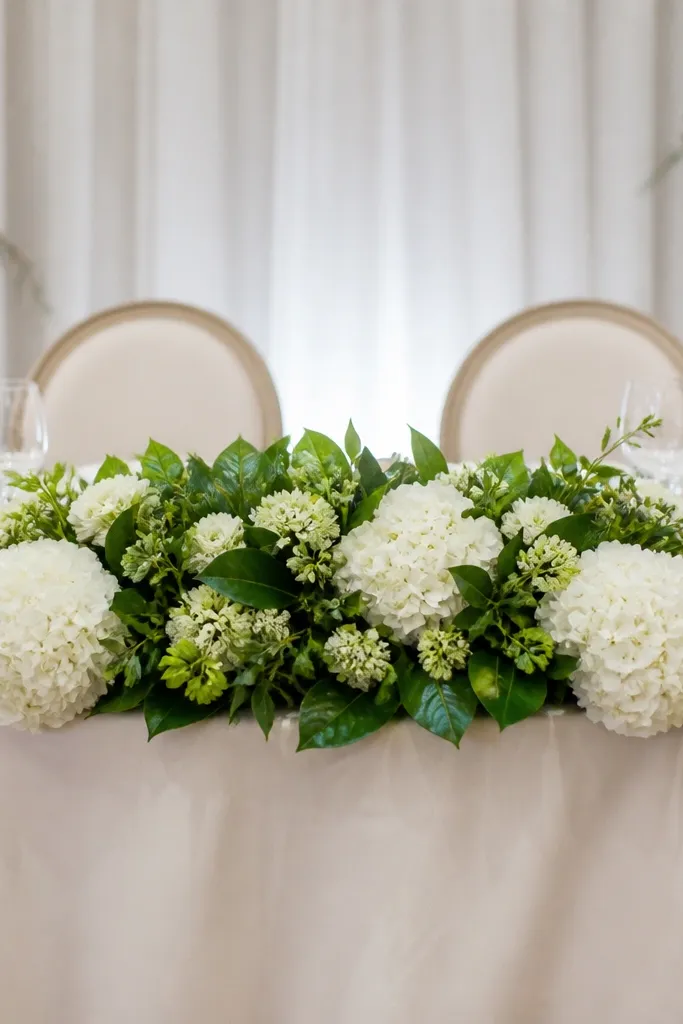
Hydrangea makes a sweetheart table look lush without needing tall stems. White hydrangea reads soft and bridal, and it stays photogenic even when the lighting is harsh. The green apple accents - think bright-lime seeded eucalyptus or green spray roses - give you a fresh lift. I keep the rest in clean greens so the table stays modern. This looks amazing with pale blue, gray, and white linens, especially if you have glass or acrylic chair backs that reflect light.
Start by placing hydrangea clusters in the corners first, so the arrangement has structure. Then fill the center with smaller hydrangea heads or spray roses if you have them. Add green-lime accents sparingly between the hydrangea so the arrangement looks intentional, not over-decorated. Finish with a flat wrap of glossy greens along the outer edge to give a neat silhouette.
Try thisHydrangea heads bruise easily - cut stems with a sharp knife and handle by the stem, not the bloom.
Common mistakeDon't overcrowd hydrangea; if it's too tight, the petals mat down and look flat.
7. Blush and sage mixed florals with soft texture
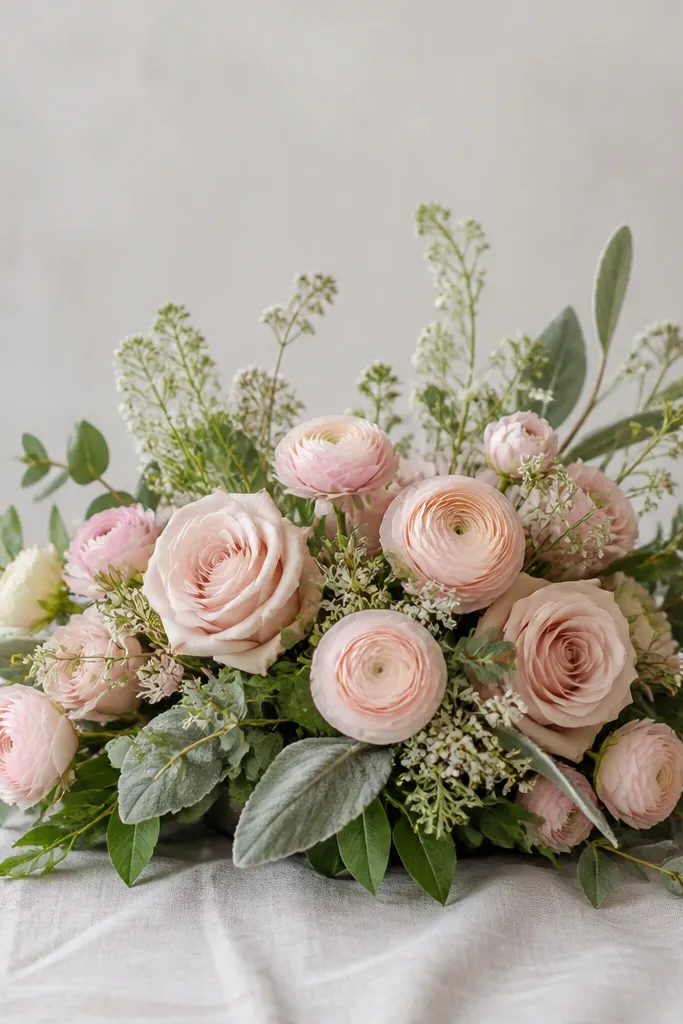
This one is for a garden-meets-modern look. Blush roses and ranunculus give you the romantic petals, while sage-green foliage makes the whole arrangement feel calm and wearable. The soft texture filler - like small white spray flowers - keeps the arrangement airy without turning it into a twig pile. I like it with linen tablecloths because the muted greens blend with the fabric and look intentional in candids. It flatters almost everyone because the palette is gentle and not too saturated.
Begin with sage foliage as your base, then layer blush roses in a low oval shape. Add ranunculus to the center and slightly to the sides for a "focus ring." Tuck small white airy flowers only where you see gaps. Keep the tallest stems at the center and trim the outer stems so the arrangement stays flat from the aisle.
Try thisTake a quick phone photo from the aisle - if it looks flat, add one more cluster to the center, not more fillers everywhere.
Common mistakeAvoid adding dusty lavender flowers; they can turn the whole palette muddy under indoor light.
8. Peach garden roses with apricot stock and ruscus
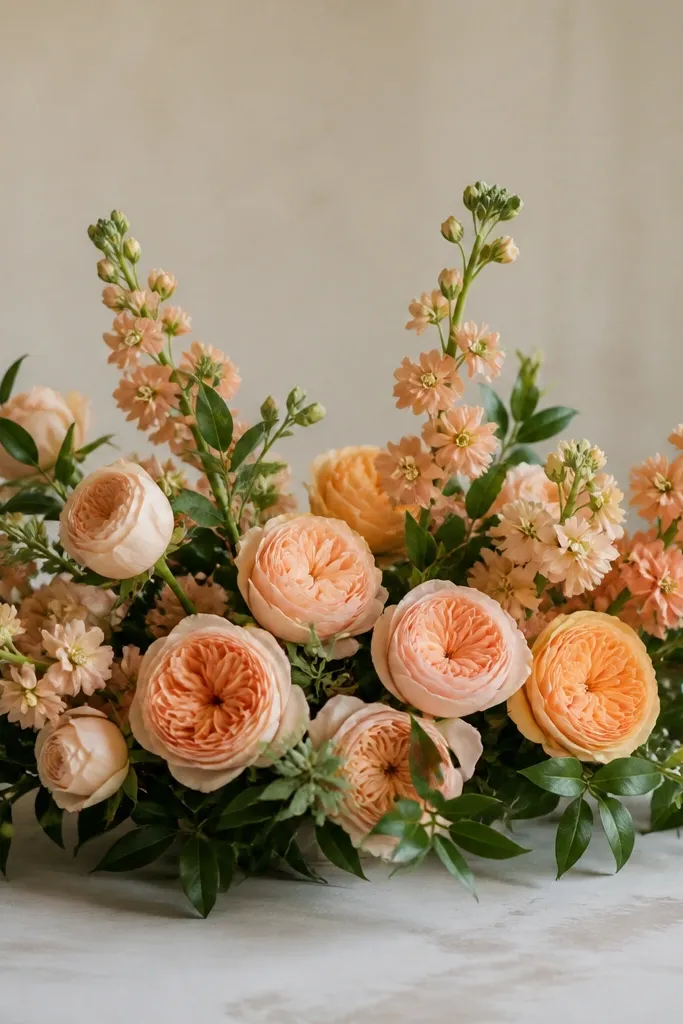
This is a warm-weather sweetheart table look that feels friendly and not overly formal. Garden roses in peach/apricot shades give you that abundant petal look, while apricot stock adds small vertical pops that show up nicely on camera. Ruscus keeps the structure tight so the arrangement doesn't sprawl. It works best with cream, ivory, or warm white linens and gold or brass candle holders. If you're worried about peach looking too orange, this mix stays balanced because the stock is lighter and the ruscus is deep green.
Start by building a tight base of ruscus across the table length you want to cover - I aim for about 30 inches. Place garden roses first, then insert apricot stock stems in small groups of 2-3 so they rise just slightly above the rose heads. Fill remaining gaps with extra rose petals or small peach blooms. Finish by trimming the front edge so it looks like a clean cushion, not a mound.
Try thisCut stock stems shorter than you think - long stock makes the arrangement look top-heavy.
Common mistakeDon't skip ruscus; airy greens alone make peach arrangements look thin.
9. All-white garden rose and dusty green eucalyptus fan
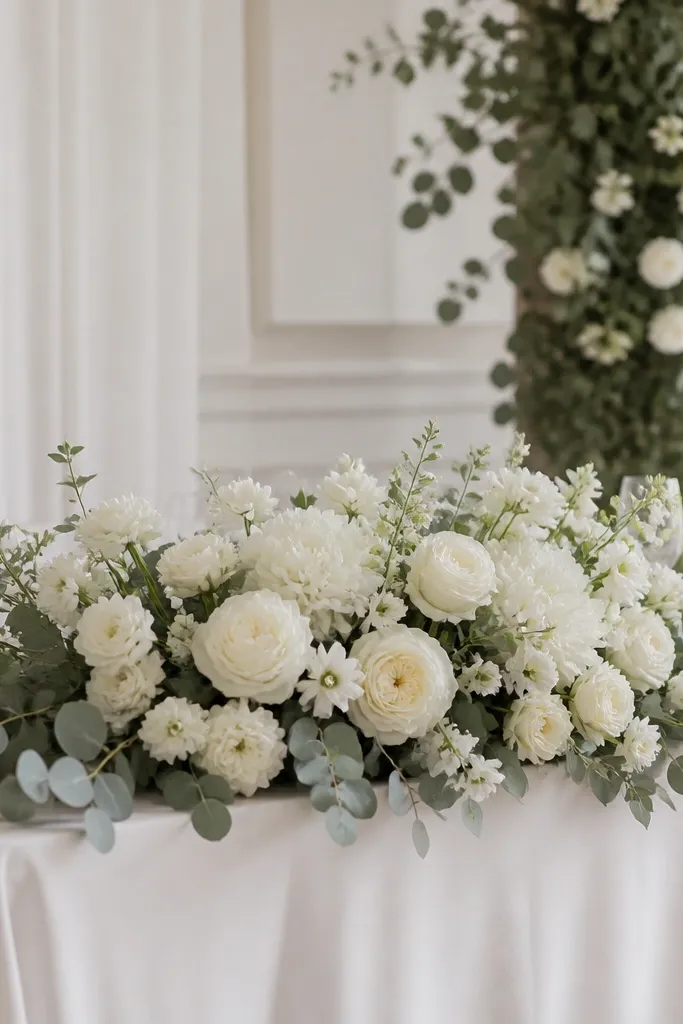
When your table styling is already busy, all-white sweetheart table wedding flowers keep everything calm. I use garden roses for the main volume, then add small white blooms for texture so the arrangement doesn't look like one flower type. Dusty green eucalyptus with silvery leaves gives shape and makes the white pop in mixed lighting. This is especially good for venues with dark walls because the silvery eucalyptus catches light. It also looks clean against white tablecloths because the eucalyptus adds contrast.
Start by placing eucalyptus along the perimeter to form a soft fan shape - keep the tips low. Add garden roses in the center, then tuck small white blossoms around the edges to fill without stacking. Keep the arrangement wide and low, and avoid adding tall filler. Finish by adjusting eucalyptus so it frames the couple evenly, with the densest part in the center.
Try thisIf your white flowers look gray in photos, add a tiny amount of pearl buds or cream spray flowers to warm them up.
Common mistakeAvoid mixing too many white varieties with different undertones; it can look accidental.
10. Peach ranunculus with blush satin ribbon ties
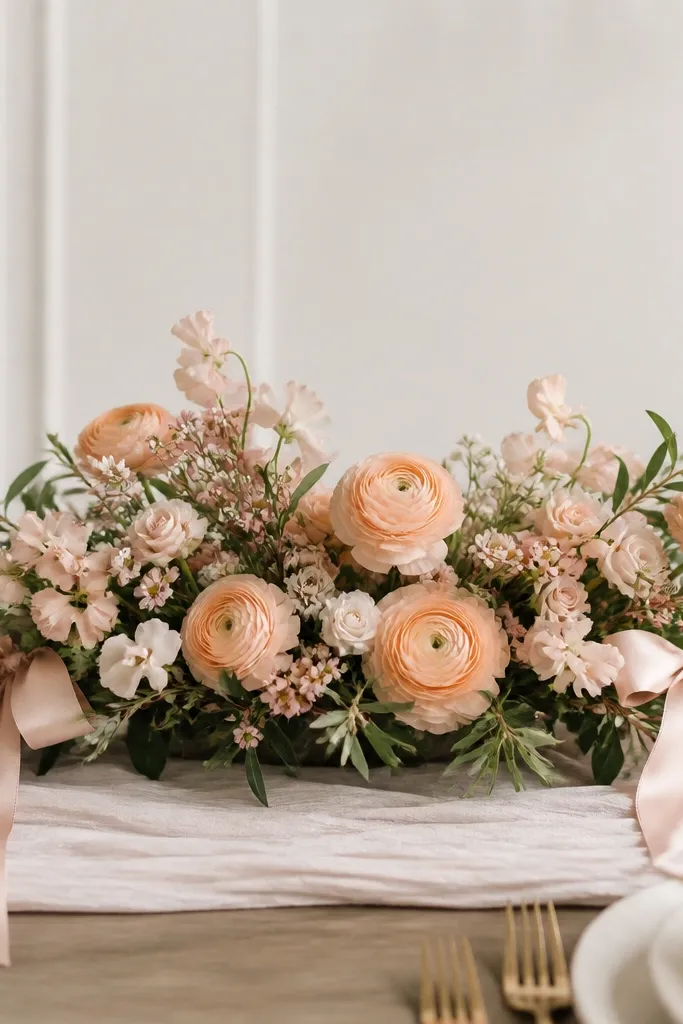
This setup is for sweetheart tables that have a soft, romantic styling - think satin runners, blush napkins, or delicate place cards. Peach ranunculus has a crisp, layered look that stays readable even when the arrangement is low. Small blush blooms fill the gaps without adding height, so the ribbon becomes the "visual punctuation." I use blush satin ribbon tied around the greenery base because it looks intentional and matches bridal details in photos. This flatters light to medium skin tones and looks especially good with warm white linens.
Start with a low base of greenery, then place ranunculus clusters across the front third of the table so they're visible from the aisle. Add small blush blooms behind the ranunculus to create depth. Tie blush satin ribbon around two points - one near each corner of the arrangement - and let the ends fall 3-4 inches over the table runner. Adjust everything so the ribbons don't cover signage or the cake table edge.
Try thisUse ribbon that's at least 1.5 inches wide; thin ribbon disappears in photos.
Common mistakeDon't tie ribbon too tightly - it can crush stems and make the arrangement look sad.
11. Royal blue delphinium with white roses and silver dusty miller
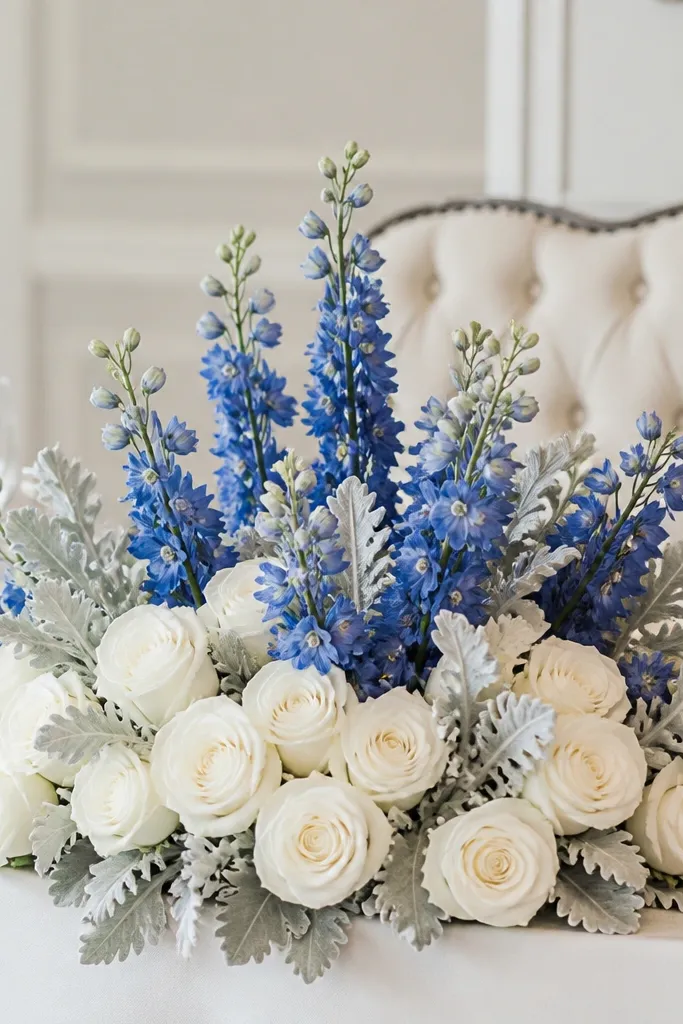
This is the "statement but still sweet" version. White roses keep it bridal and clean, while delphinium spikes add that sky-blue drama that reads from far away. Dusty miller brings a silver backdrop that makes the blue look sharper, not muddy. I keep the delphinium controlled so it rises only at the center - too much height blocks faces. This works beautifully for winter weddings, navy accents, or any venue with cool-toned lighting.
Start by building a low cushion with white roses and greenery, keeping everything under 14-16 inches at the outer edges. Insert delphinium stems in the center group first, with 3-5 spikes fanned slightly outward. Add dusty miller behind the roses to create a silver layer, then trim any miller that shows past the arrangement edge. Finally, check the arrangement from the couple's eye line so the spikes don't block guests' faces.
Try thisDelphinium sheds - hold it over a clean sheet when styling and wipe stray petals off the table runner.
Common mistakeAvoid adding too many other blue flowers; one strong blue element is what makes it look designer.
12. Coral roses with orange marigold-style blooms and dark green
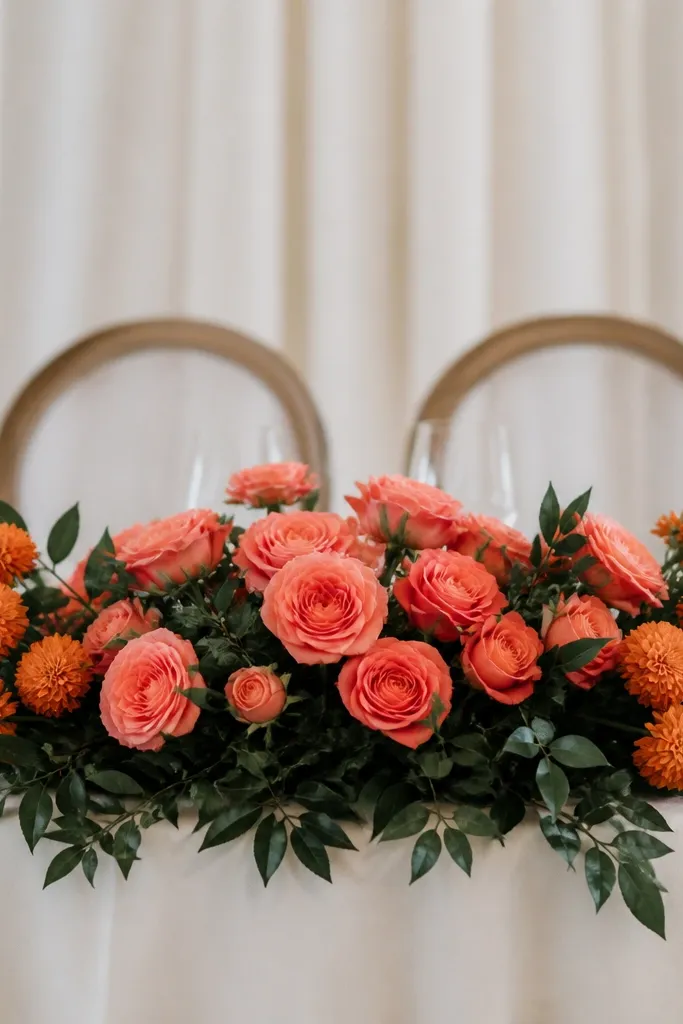
This arrangement has a lively, sunset energy that still photographs well because the coral roses anchor it. The marigold-style blooms create a sunny border and add a little texture that reads like confetti - but it stays controlled because they're only on the sides. Dark green leaves keep the colors grounded so it doesn't look like a craft fair bouquet. It's perfect for late summer and for weddings with warm terracotta, copper, or rust accents. It also looks great with black candles and matte gold flatware.
Start with dark green foliage as a base and build a low rectangle shape across the table. Place coral roses as the main center cluster and keep them slightly denser in the middle for a focal point. Add marigold-style blooms only at the outer third on both sides, then fill the rest with small green leaves to hide stem ends. Keep the top flat and trim any long stems so the arrangement stays under 15 inches.
Try thisIf your venue is windy, anchor the base with a heavier liner so the side blooms don't shift.
Common mistakeDon't let marigold-style blooms drift into the center - that's where it starts to look messy.
13. Lavender lisianthus and blush roses with sage eucalyptus
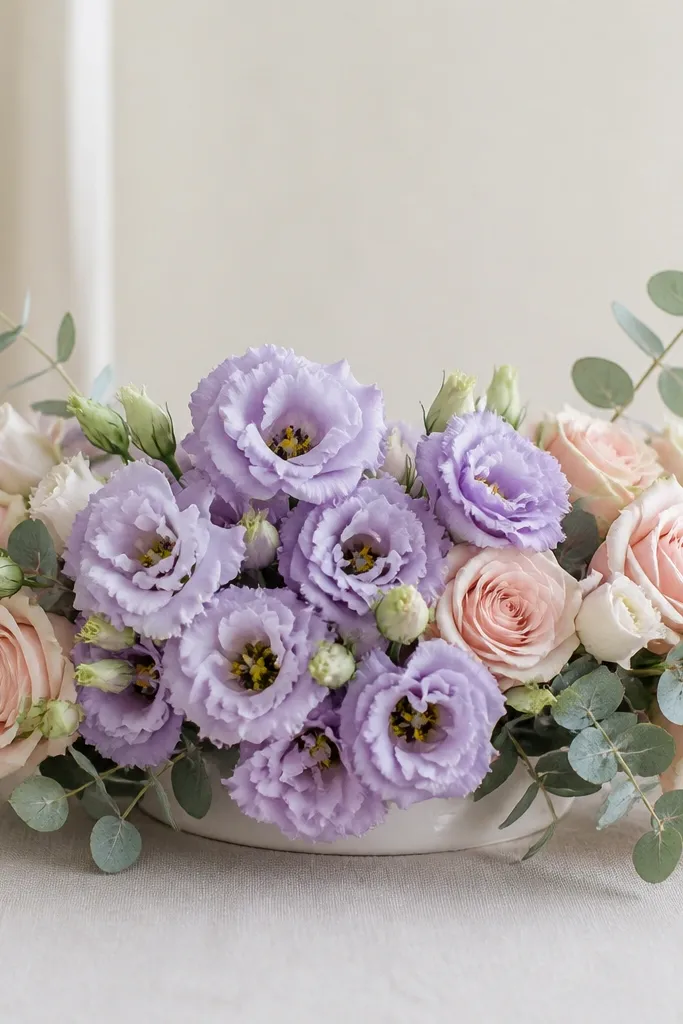
Lavender lisianthus gives you a soft, airy look without losing structure. Pairing it with blush roses keeps it romantic and prevents the lavender from reading too "lilac candle" in photos. Sage eucalyptus ties the palette together and adds a natural, calm background. This works well for spring weddings and for couples who want something pretty but not pastel-sugar sweet. It also looks good on darker linens because the lavender pops more clearly.
Begin by building a sage eucalyptus base, then place blush roses along both sides in a low arc. Add lavender lisianthus in the center cluster, using groups of 3-4 blooms so the color stays concentrated. Fill gaps with small white filler flowers or extra eucalyptus, then trim the outer edge so it's neat and flat. Keep the lisianthus slightly taller than the roses by 2-3 inches for depth, not height.
Try thisLisianthus bruises - cut stems early, keep them cool, and avoid handling petals with bare fingers.
Common mistakeAvoid mixing strong magenta flowers with lavender; it turns the palette harsh.
14. Tropical white orchids with green palm and ginger buds
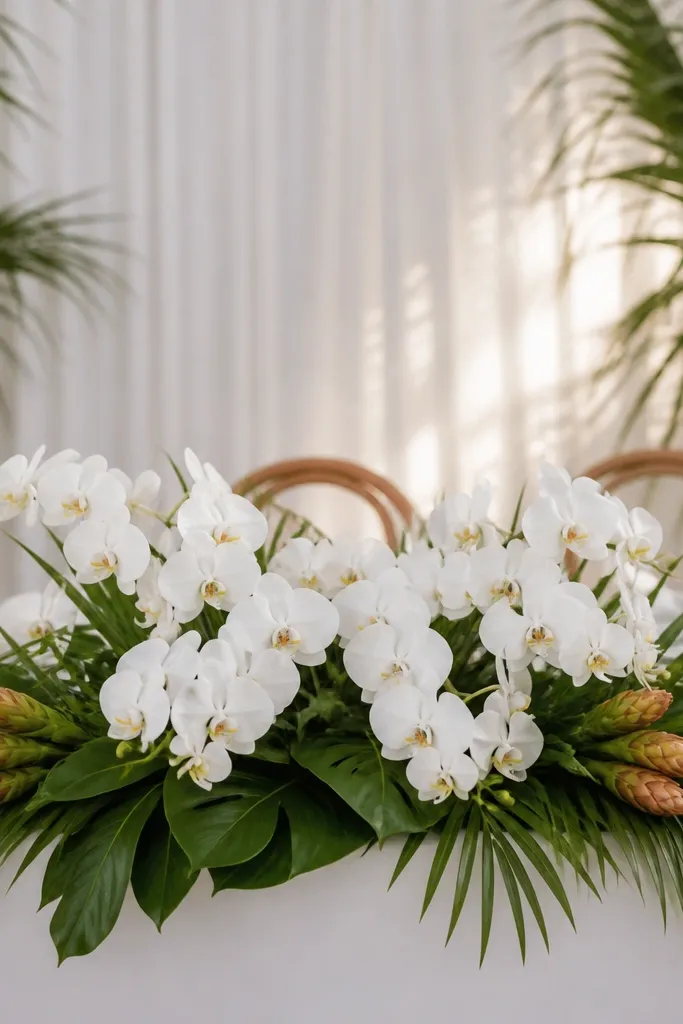
This is for destination weddings or anyone who wants a modern romance with a tropical twist. White orchids give you that clean, architectural petal shape that looks expensive even in a simple arrangement. Palm and glossy greens add shine and movement, while ginger-like buds bring warmth at the corners. I keep the orchid blooms in a line across the center so they look intentional, not scattered. This works especially well with linen in warm white and gold chargers because the greens and orchids reflect light nicely.
Start with glossy green leaves as your base, layering them to form a low platform. Place orchids first - I do 3-5 blooms across the center line depending on table width. Tuck ginger-like buds near the front corners so they frame the couple. Add palm fronds behind the orchids for a subtle halo effect, then trim fronds so they don't rise above 16 inches. Finish by cleaning up the edges so the base looks smooth from the aisle.
Try thisKeep orchids hydrated in a bucket right up to install; they perk up fast if the stems stay cool.
Common mistakeAvoid too many different tropical textures; pick orchids plus one green family.
15. Deep green and white anemone clusters with black accents
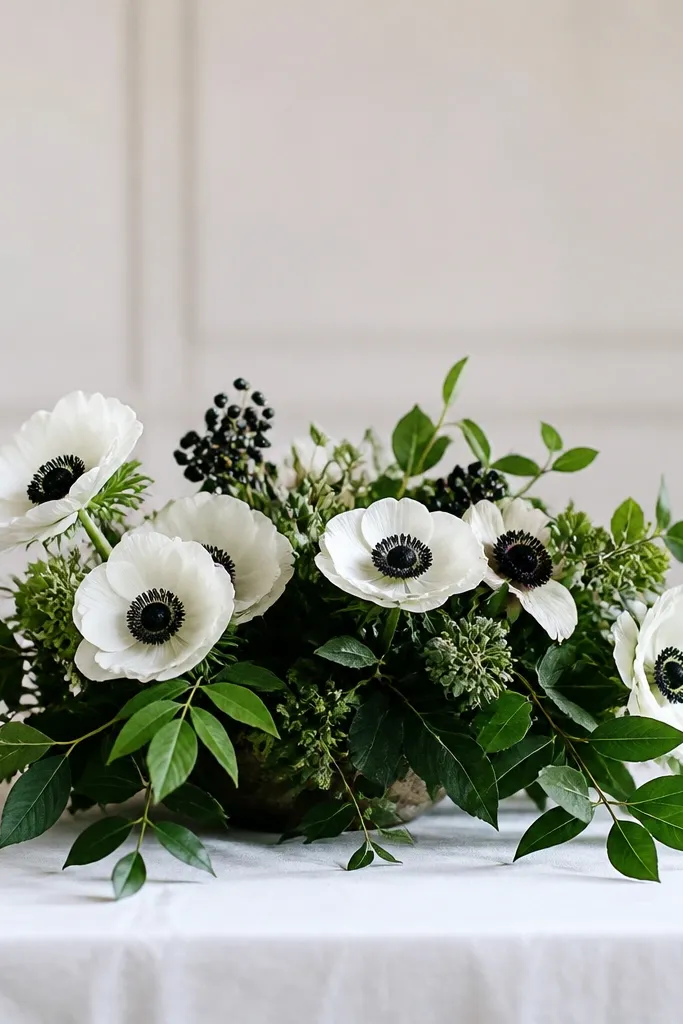
This arrangement looks modern and photo-friendly because the anemone centers create a built-in focal point. White petals keep it bridal, while the dark centers add drama without needing tall flowers. I use deep green leaves to create a thick, grounded base that keeps everything crisp. If your table has black candle cups, dark signage, or modern stationery, this fits perfectly. It flatters a wide range of skin tones because the contrast is in the flowers, not the palette.
Start with a dense base of deep green leaves, then place anemone clusters at the center and slightly toward the front so the dark centers face outward. Add a few black accents behind the front row, spaced like punctuation marks. Keep filler minimal - you want the anemones to be the main event. Finally, trim the arrangement so it forms a low, even plane, not a mound, and check it from the aisle for symmetry.
Try thisAnemones look best when the dark centers face the camera; rotate blooms before trimming stems.
Common mistakeDon't add lots of small white filler flowers; it can turn the arrangement into a snowball.
16. Monochrome blush roses with oversized cream peony-like blooms
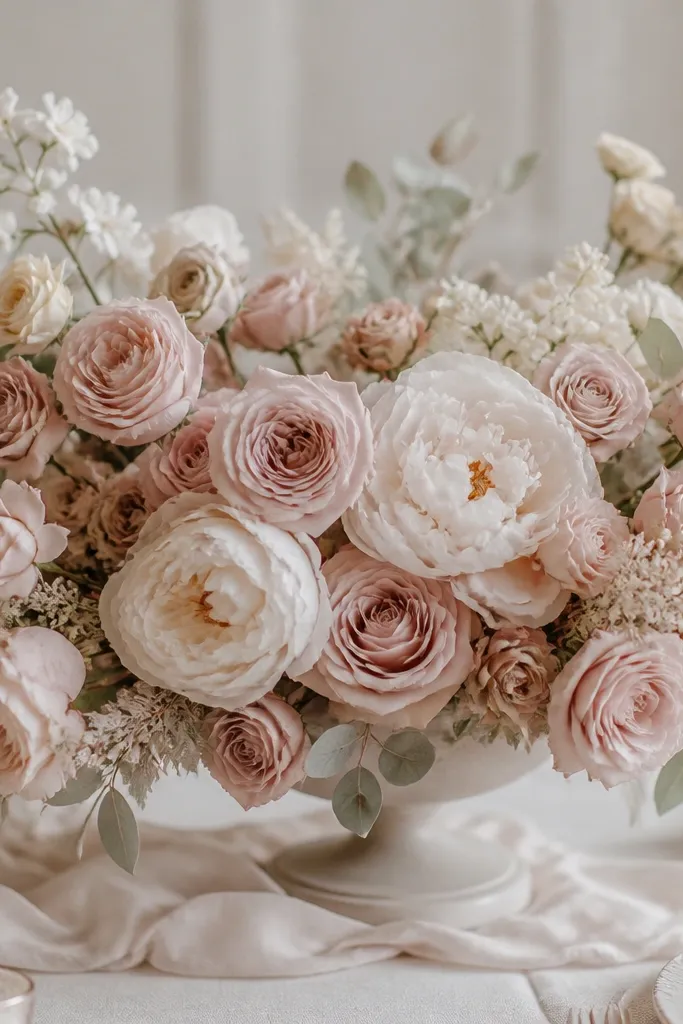
This is the "soft but not boring" monochrome look. When you use blush roses consistently and then add a few oversized cream peony-like blooms, you get dimension without loud color changes. I like this for venues with neutral décor because the flowers carry the styling. The lighter cream heads create highlights that show up even in warm indoor lighting. It's flattering for anyone who wants a romantic table without going full pastel.
Start by building a pale-green base using ruscus or soft eucalyptus, keeping it low and evenly spread. Place blush roses first in a wide band, then add cream peony-like blooms in the center as the main anchors. Fill small gaps with extra blush rose clusters, but keep the overall height consistent so it doesn't look layered on top of itself. Finish by trimming all stems to match the silhouette from both sides - the arrangement should look tidy at the edges.
Try thisUse a handheld steamer on the leaves right before install; it removes wrinkles and makes greens look fresh.
Common mistakeAvoid mixing in taupe or gray flowers unless you want a more muted, less bridal look.
17. Cream roses with champagne taper-candle halo
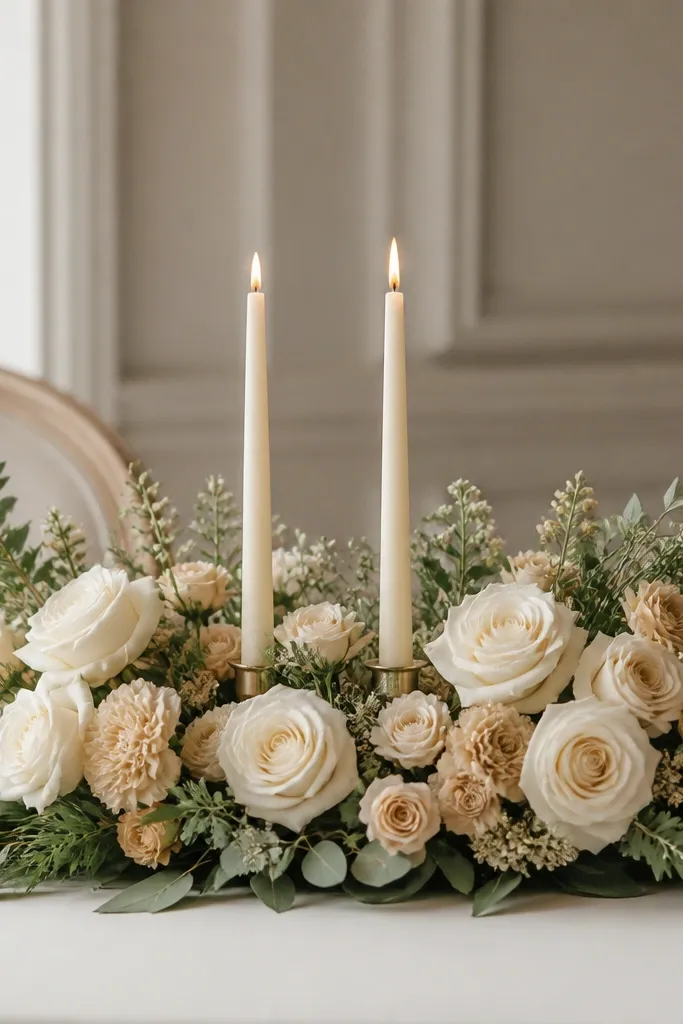
Candles change how sweetheart table wedding flowers look because they create light behind the blooms. This arrangement is designed around two taper candles placed in the center - the flowers wrap the candle halo but stay low so the flames aren't surrounded by petals. Cream roses with champagne-toned small blooms look warm and flattering, and the greenery keeps the ring from looking delicate. This is a great choice for evening weddings with dim lighting because the candle glow makes the petals look creamy, not washed out.
Start by placing two taper candles on the table and measuring the space around them. Build a ring of greenery and small blooms first, then place cream roses at equal intervals around the ring. Keep taller stems behind the candles so the front stays flat and readable. Add small filler buds only where you see stem ends, then adjust the greenery so the ring looks continuous from the aisle.
Try thisUse LED tapers for the ceremony rehearsal and test your arrangement height before real candles go in.
Common mistakeAvoid placing heavy, wet floral foam near candles; keep the structure dry and stable.
18. Sunflower meadow mix with white stock and sage
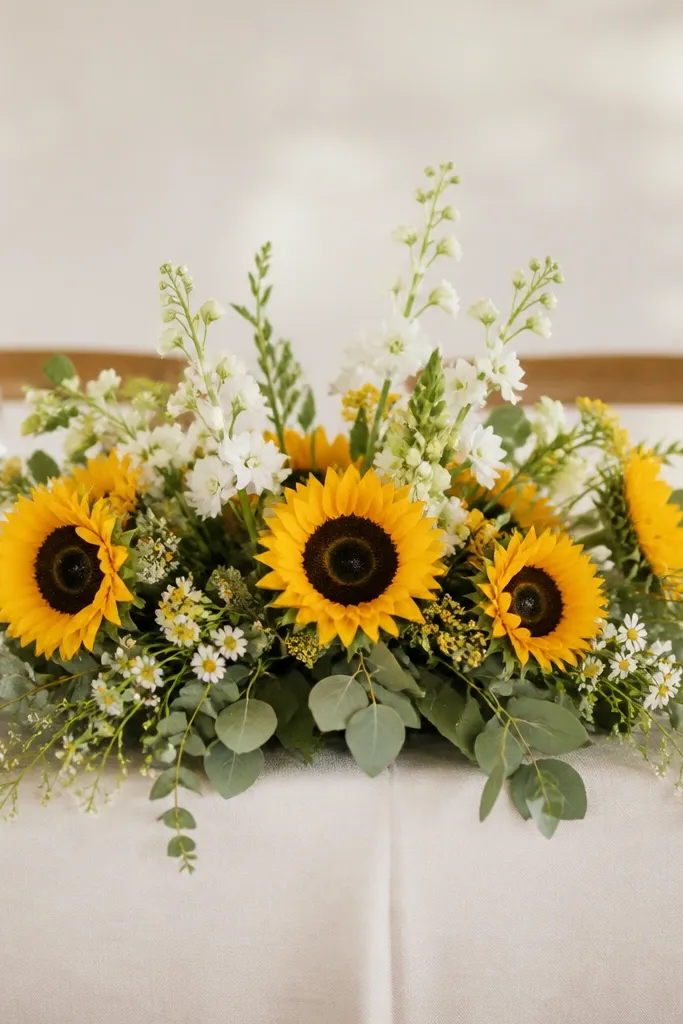
Sunflowers on a sweetheart table can look classy if you keep the arrangement low and give it structure. The sunflower heads are bold, so pairing them with white stock adds vertical rhythm without making the centerpiece tall. Sage greenery keeps it from turning into full "barn wedding" energy. I also like the way white stock reads clean against yellow - it balances the warmth. This works for summer weddings and for couples who want cheerful photos without drowning the table in bright colors.
Begin with sage greenery as the dense base across the table width you want to cover. Place sunflower heads at the center and corners, then insert white stock blooms in small clusters so they rise 2-4 inches above the base. Add a few wildflower-like sprigs only at the outer edge for texture. Keep everything trimmed so the arrangement stays under 16 inches and the sunflowers face outward from the couple.
Try thisIf sunflowers droop, re-cut stems and submerge heads in cool water for 30 minutes before styling.
Common mistakeDon't add too many small yellow blooms; it turns the arrangement into a blur instead of a focal point.
19. Soft peach and champagne spray rose waterfall on corners
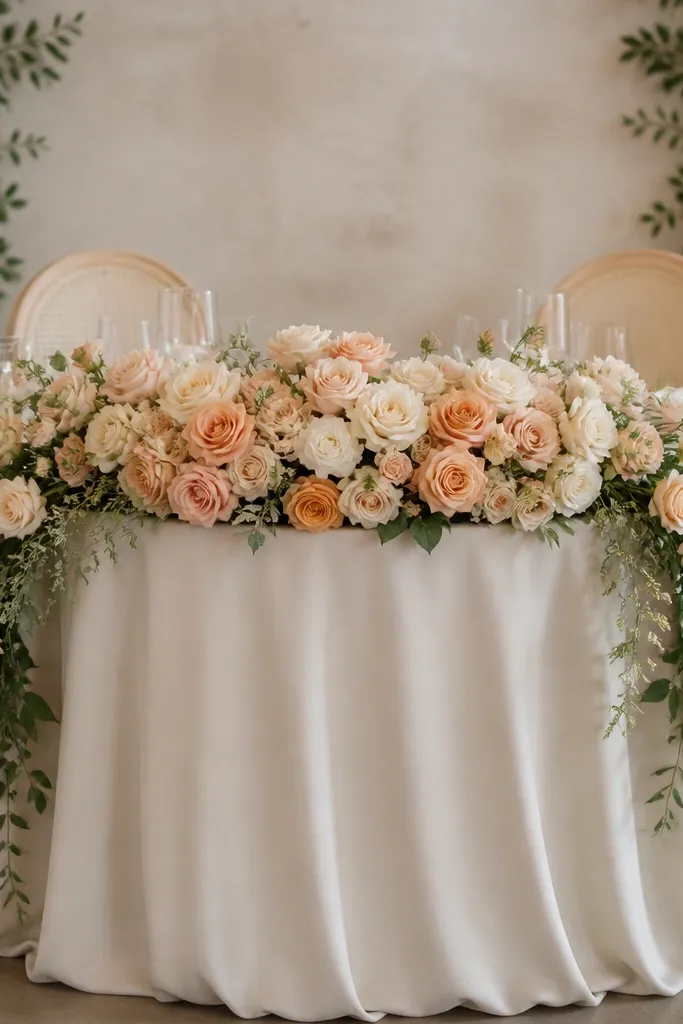
This one gives you a dressed-up look without tall center height. Spray roses look delicate but they fill space fast, so you get a lush cushion even if you're working with limited flower volume. The corner drapes create movement that photographs well because they lead the eye toward the couple. I keep the waterfall only on the corners so it doesn't interfere with place settings. It flatters most color palettes, especially peach, champagne, cream, and light gold décor.
Start by making a low base with light greenery, keeping it tight so it holds the spray rose weight. Place peach spray rose clusters across the center cushion, then add champagne spray rose in the back half for depth. For the corner drapes, take longer stems and wire them to the base so they fall 3-5 inches over the table edge. Tuck small leaves into the drape so it looks full, then trim the front edge into a clean line.
Try thisWire your drape stems in advance and test the fall length with a phone photo before final install.
Common mistakeAvoid draping in the middle; it makes the centerpiece look like it collapsed.
20. Rose Quartz Sweetheart Table with Blush Garden Rose Pomanders
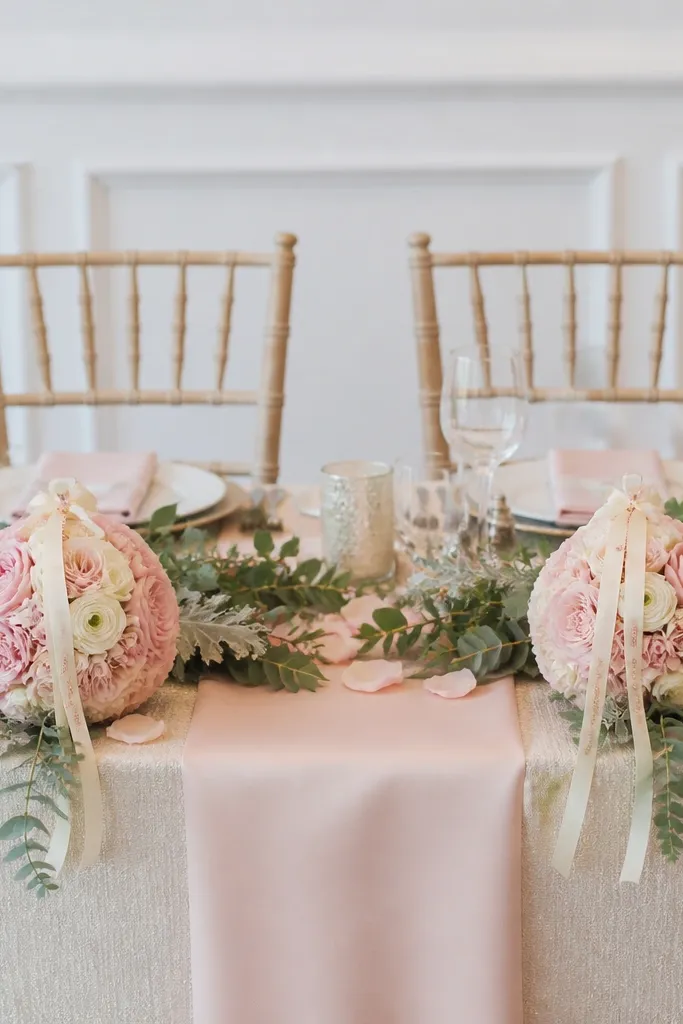
This arrangement gives you a romantic look that still feels fresh and wearable, because the main flowers are built into rounded pomanders instead of a heavy long runner. I used blush garden roses and pale spray roses for the "rose quartz" feel, then added ranunculus for that layered, petal-within-petal texture. Hanging the pomanders slightly above the table keeps the sightline open so photos look airy, not blocked by tall stems. It also photographs well from the side, since the round shape frames the couple instead of stretching only horizontally.
Step 1: Build two foam-free pomanders by wiring a small chicken-wire sphere, then tuck short-cut stems into the gaps with floral tape. Start with blush garden roses as your anchor points, and fill the spaces with spray roses and ranunculus so the surface stays evenly rounded. Step 2: Tie each pomander with thin ivory ribbon so it hangs 6-10 inches above the table runner, and secure the ribbon knots with a small dab of hot glue so they do not slip. Step 3: Add dusty miller and baby eucalyptus around the base edge of each pomander, then scatter a few petals along the runner for movement. Step 4: Finish with rose quartz-style glass beads at the ribbon knots and a couple of small bead clusters tucked into the greenery so the sparkle stays concentrated near the couple's eye level.
Try thisHang the pomanders from a clear command hook or a discreet stand so you can adjust height during setup - I always raise them slightly for photos and lower them for guests. Use short stems for pomanders so nothing flops forward onto the plates.
Common mistakeDo not use long, untrimmed stems on a hanging pomander - they twist and make the whole ball look lopsided by the time you get to cocktail hour.